

Why a Calibration Deficiency Can Detain Your Vessel in Port Klang
What Happens When a PSC Inspector Finds a Non-Calibrated Instrument
A Port State Control inspector boards a vessel at Port Klang under Malaysia’s obligations as a Tokyo MOU member. During the fire safety equipment check, the pressure gauges on the vessel’s CO2 fixed suppression system are issued certificates by a non-accredited workshop. Two are expired. The inspector raises a deficiency under SOLAS Chapter II-2. The vessel cannot depart until the instruments are recalibrated and documented. Port dues, crew idle costs, and charter penalties accumulate from that hour.
Malaysia is one of the most active PSC inspection states in Southeast Asia and a full member of the Tokyo MOU, the regional Port State Control arrangement covering 21 Asia-Pacific administrations. PSC inspection programmes operate at Port Klang, Penang, Johor, and Miri, with fire safety and life-saving appliance equipment among the most commonly cited deficiency categories.
The cost imbalance makes pre-port compliance logical. A comprehensive vessel calibration programme costs a fraction of one day’s PSC detention.
The Two Separate Regulatory Frameworks That Apply to Your Vessel at the Same Time
SOLAS applies to the vessel wherever it operates, setting minimum standards for safety-critical equipment including instruments used in fire detection, navigation, and machinery monitoring. Port State Control under the Tokyo MOU is the enforcement mechanism at port. Malaysian maritime officers have authority to inspect SOLAS compliance and detain vessels that do not meet requirements.
These two frameworks create a layered obligation. SOLAS requires safety-critical instruments to be maintained and tested at defined intervals. PSC inspectors interpret “maintained and tested” as requiring documented, traceable verification of instrument accuracy. Crew-recorded functional tests alone are not sufficient evidence for instruments where accuracy determines safety.
SOLAS Requirements and Class Society Rules That Govern Marine Instrument Calibration
What SOLAS Actually Says About Instrument Calibration and Maintenance
Three SOLAS chapters create the core calibration obligation. Chapter III requires periodic testing of life-saving appliance equipment with records maintained onboard. Chapter V requires navigational instruments to be maintained in efficient working order. Fire detection systems and fixed firefighting systems fall under Chapter II-2, which mandates testing and maintenance in accordance with SOLAS requirements and manufacturer specifications.
SOLAS sets performance requirements but does not always specify that calibration must be performed by an external accredited laboratory. Class societies and PSC interpretive guidance fill that gap in practice.
How Class Society Survey Requirements Define the Calibration Standard in Practice
What Classification Society Annual and Special Surveys Expect for Instruments
Class societies, including Lloyd’s Register, DNV, Bureau Veritas, ClassNK, and the American Bureau of Shipping, require instruments critical to vessel safety to be calibrated at defined intervals, with documentation available to surveyors. Certificates from onboard crew or non-accredited workshops may not be accepted as evidence of compliant calibration during annual or special surveys.
How the ISM Code Creates Documentation Requirements
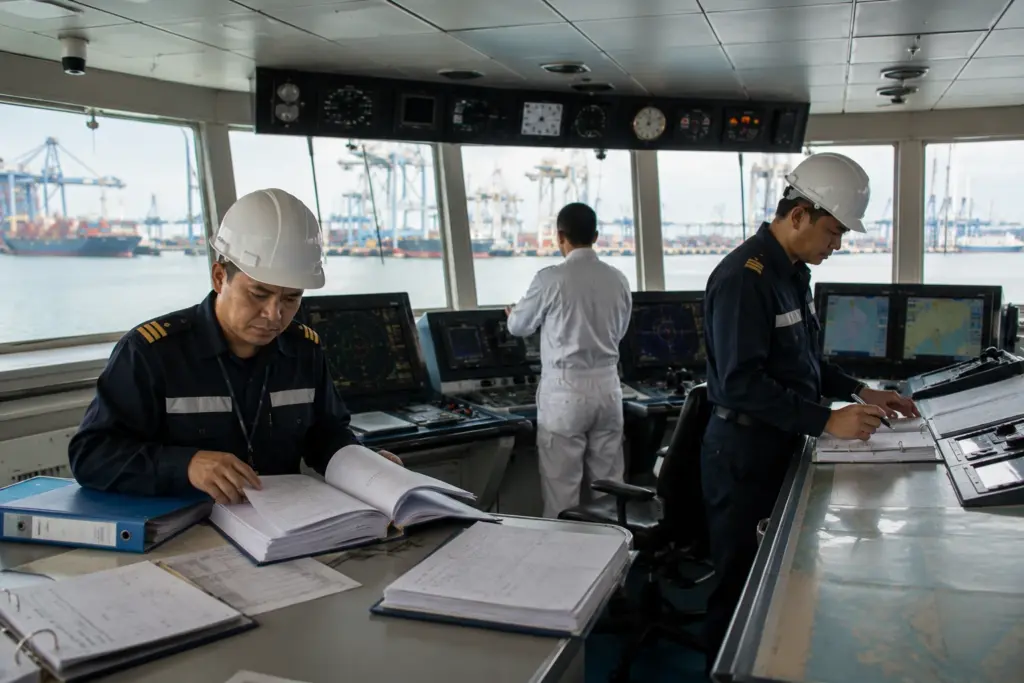
ISM Code Chapter 10 requires a planned maintenance system covering all equipment essential for safe operation. The Ship Safety Management System must contain procedures for verifying instrument accuracy, the record of calibration performed, and a process for managing instruments found outside tolerance. An undocumented calibration is treated as an incomplete one during a PSC inspection.

What the Tokyo MOU Concentrated Inspection Campaigns Mean for Malaysian Port Calls
The Tokyo MOU publishes annual concentrated inspection campaigns targeting specific equipment categories across all member administrations simultaneously. When a campaign targets fire safety or enclosed space entry equipment, PSC officers at Port Klang, Penang, Johor, and Miri are directed to examine those categories with heightened scrutiny. Vessels calling during a relevant campaign face more detailed review of pressure gauge and gas detection records than during routine inspections.
Which Instruments on Commercial Vessels Require Calibration in Malaysian Waters
Safety-Critical Instruments Subject to Mandatory Calibration Evidence
Fire System Pressure Gauges and Detection Instruments
Pressure gauges on CO2 and sprinkler fixed fire suppression systems monitor agent storage pressure. An inaccurate gauge may indicate sufficient charge when the system is depleted, or fail to trigger an alarm for a pressure drop. Class societies typically require annual or biennial calibration by an accredited source, with the certificate identifying the equipment by serial number and stating measured deviation at defined pressure points.
Bilge Level Sensors and Alarm Systems
Not every calibration deficiency involves a complex instrument. Bilge level alarms are straightforward devices, but SOLAS requires them in machinery and pump well spaces precisely because undetected water ingress is among the leading causes of vessel loss. Functional testing confirms the alarm activates at the set point. Calibration confirms that the set point is accurate relative to a known reference level. PSC inspectors who find only crew-recorded functional tests with no external verification may raise this as an ISM deficiency.
Machinery Monitoring Instruments: Pressure and Temperature Gauges
Modern automated alarm systems on commercial vessels rely on pressure and temperature sensor readings to trigger protective shutdowns. An inaccurate lube oil pressure sensor that reads higher than the actual pressure may fail to trigger an alarm at the correct threshold, allowing a bearing failure to progress beyond the intervention range. For these instruments, the service interval should reflect the marine operating environment rather than standard industrial intervals.
Gas Detection Instruments in Cargo Holds and Engine Rooms
More seafarers die from enclosed space incidents than from any other single operational cause. SOLAS Regulation III/19 requires gas testing before and during entry using instruments confirmed to be in good working order. A bump test confirms sensor response. Only calibration against a certified reference gas mixture confirms that the displayed concentration is accurate. Class societies and PSC inspectors increasingly require both bump test logs and calibration certificates for gas detection equipment.
Navigational Instruments and Their Specific Calibration Requirements
Magnetic Compass Deviation Tables
A deviation table records the systematic error of the ship’s magnetic compass on different headings. It must be updated after structural alterations affecting the magnetic environment and prepared by a qualified compass adjuster. PSC inspectors examine whether the table is current and covers all major headings.
Navigation Sensor and ECDIS Performance Standards
IMO performance standards require GPS receivers, speed logs, and echo sounders to be maintained in working order. ECDIS type approval and software update requirements create a maintenance trail that PSC inspectors examine during navigational equipment checks.
Instruments Specific to Tankers, Gas Carriers, and Chemical Tankers
Cargo Measurement Instruments on Tankers
At Malaysian oil terminals, inaccurate cargo measurement is not just a technical issue. Custody transfer of petroleum products creates commercial and legal exposure when the measurement cannot be traced to a national standard. Cargo measurement instruments on tankers including flowmeters and tank level gauges carry calibration obligations under Malaysia’s Weights and Measures Act in addition to class society requirements.
Gas Carrier Instrument Requirements Under the IGC Code
The IGC Code requires temperature and pressure monitoring instruments on LNG and LPG carriers to be maintained to standards appropriate for cargo safety. Class survey intervals for gas carrier instruments are typically shorter than for bulk carriers or general cargo vessels due to the safety-critical nature of cargo containment monitoring.
What a Compliant Marine Calibration Certificate Must Contain
The Four Elements a Marine Calibration Certificate Must Show
Required Element | What It Must State | Why PSC and Class Surveyors Require It |
Laboratory accreditation status | Accreditation body name and scope reference | Confirms traceability to national or international standards |
Instrument identity | Make, model, and serial number | Links the certificate to a specific instrument onboard |
Calibration results | Measured values and deviation at each test point | Provides evidence of accuracy, not just a pass/fail statement |
Validity period | Calibration due date or recommended next interval | Allows the SMS to manage renewal timing |
Why an ILAC MRA Accredited Laboratory Certificate Satisfies Malaysian Port Authority Inspection
What ILAC MRA Means in a Maritime Context
The ILAC Mutual Recognition Arrangement connects national laboratory accreditation bodies so that certificates from any signatory member country are recognised as technically equivalent. Malaysia’s Department of Standards Malaysia (DSM) and Singapore’s SAC-SINGLAS are both ILAC MRA signatories. A certificate from a SAC-SINGLAS accredited laboratory carries the same technical standing at a Port Klang PSC inspection as one from a DSM-accredited Malaysian laboratory. Vessels that calibrate in Singapore before a Malaysian port call do not need to repeat the service.
When an Onboard Calibration or Manufacturer Calibration Certificate Is and Is Not Sufficient
Manufacturer factory calibration is acceptable for new instruments that are still within the stated factory validity period at the initial class survey. Once installed in a vessel’s operating environment of vibration, salt air, and temperature cycling, the factory assumption no longer holds after the defined acceptance window. For safety-critical instruments, including fire system pressure gauges, gas detectors, and custody transfer instruments, crew functional test records do not substitute for an externally accredited certificate during a PSC inspection or class survey.
Calibration Interval Requirements for Marine Instruments
How Calibration Intervals Are Set for Instruments on Commercial Vessels
Three sources define the interval: class society rules, manufacturer recommendations in the service manual, and the vessel’s SMS. Marine intervals are typically shorter than equivalent industrial ones because vibration, salt air, temperature cycling, and physical shock accelerate drift and physical wear. Applying a standard 24-month industrial interval to marine instruments creates real risk of out-of-tolerance findings before the certificate expires.
Specific Intervals Commonly Required by Major Class Societies
Annual calibration is typically required for pressure gauges on fire suppression systems and for gas detection instruments used in enclosed-space entry. Biennial or special survey calibration applies to navigational instruments including speed logs, depth sounders, and compass deviation tables. Cargo monitoring systems on tankers and gas carriers are often tied to the class renewal survey cycle.
How to Conduct a Pre-PSC Calibration Compliance Self-Audit Before Calling at a Malaysian Port
Step 1: Build a Complete Instrument Calibration Register for the Vessel
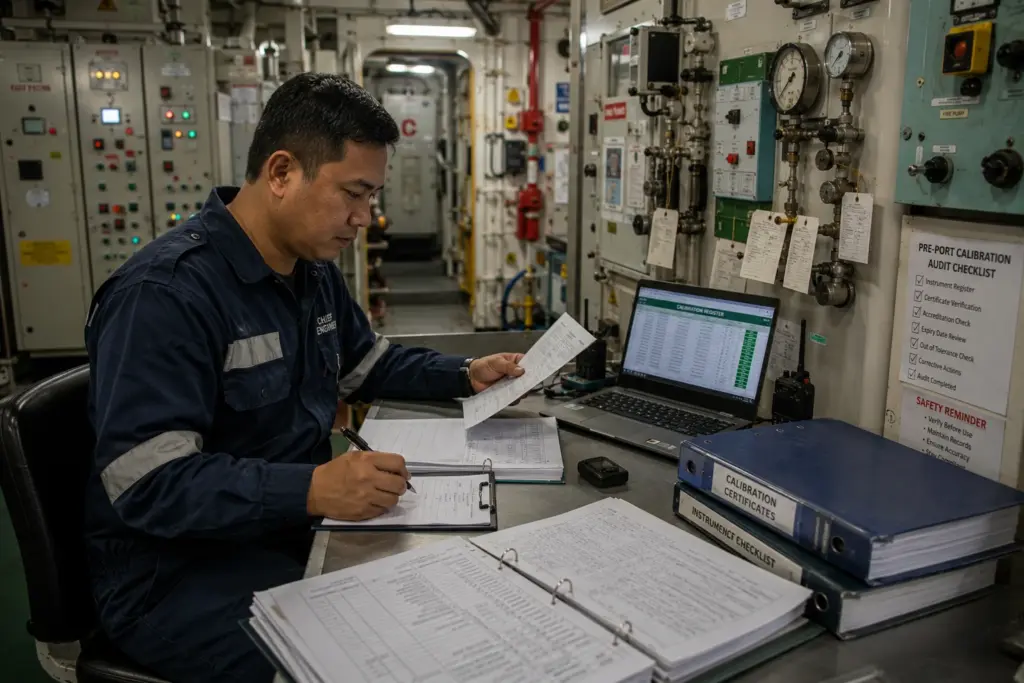
The register must identify every safety-critical instrument by location, make, model, serial number, current calibration status, due date, and the name and accreditation status of the issuing laboratory. A register makes approaching due dates immediately visible, allowing the service to be scheduled well before port arrival rather than discovered at the dock.
Step 2: Verify Laboratory Accreditation for Every Certificate in the File
Search the ILAC database, the DSM website, or the SAC website to confirm current accreditation status and check that the specific measurement parameter falls within the laboratory’s declared scope. A certificate issued outside the laboratory’s accredited scope is not a traceable document, regardless of the laboratory’s general accreditation status.
Step 3: Check Certificate Currency and Schedule for Instruments Expiring Within 90 Days
Ninety days is the correct planning horizon. Port call schedules change, appointments require lead time, and waiting until a certificate has expired creates non-compliance risk at the next port. On-site calibration aboard the vessel is an option for equipment that cannot be removed, such as certain pressure gauges and fixed gas detection systems.
How ILAC MRA Accredited Calibration Laboratories Serve Vessels Calling at Malaysian Ports
Atlantic Services Malaysia is one example of a SAC-SINGLAS accredited calibration laboratory based in Ipoh, Perak, that provides marine instrument calibration services for vessels operating in Malaysian waters, issuing certificates recognised under the ILAC MRA framework at Malaysian port PSC inspections.
Conclusion
Marine instrument calibration in Malaysia is governed by both SOLAS, an international convention, and Port State Control enforcement under the Tokyo MOU at Port Klang, Penang, Johor, and Miri. The primary instrument categories requiring accredited certificates include fire system pressure gauges, gas detection instruments for enclosed space entry, bilge alarm sensors, machinery monitoring instruments, and cargo measurement systems on tankers. Every compliant certificate must identify the equipment by serial number, state the measured values and any deviations, confirm the issuing laboratory’s ILAC MRA-accredited status, and carry a stated validity period. The pre-PSC self-audit has three steps: build a complete calibration register, verify laboratory accreditation for each certificate in the file, and schedule renewal for any items expiring within 90 days. A PSC detention costs multiples of what an annual maintained calibration programme costs. The time to confirm compliance is before the inspector boards, not after.