
The Discovery That Costs the Most: When a Certificate Gets Rejected
Why Calibration Certificates Are Challenged During Malaysian Audits and Inspections
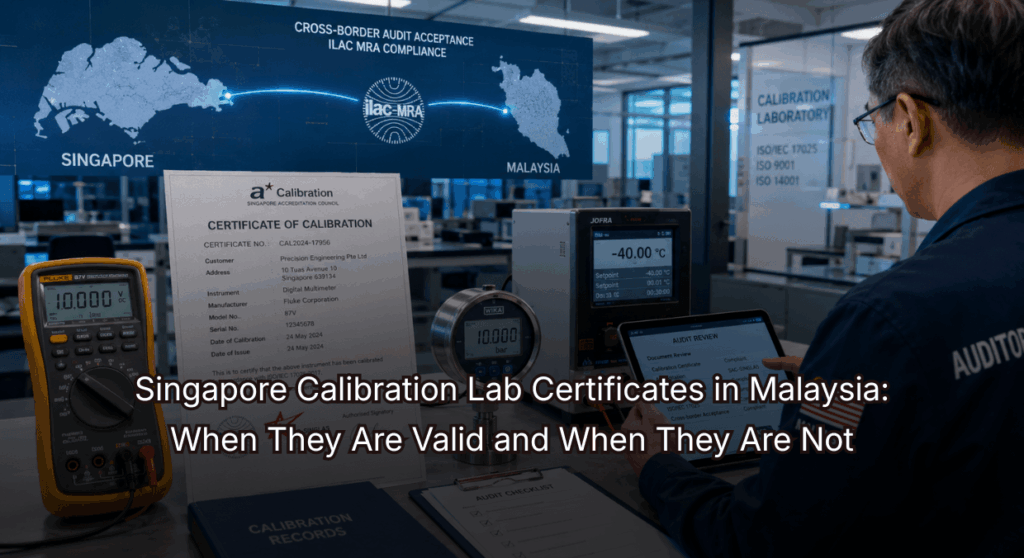
The scenario is more common than operators expect. A Malaysian manufacturer submits calibration certificates from a Singapore laboratory to a PETRONAS vendor audit or a DOSH statutory inspection. The auditor flags them. The measurements are not the problem. The problem is that the issuing laboratory does not hold accreditation that this particular authority recognises.
Instruments are already deployed. Re-calibration takes time. The audit is today.
The Difference Between “Technically Valid” and “Regulatorily Accepted”
A technically valid calibration certificate has measurements traceable to SI units, stated measurement uncertainty, and results produced by a competent laboratory. A regulatorily accepted certificate has all of that, plus it comes from a facility whose accreditation body the specific Malaysian authority or client contractually recognises. A certificate can be technically sound and still be rejected. The gap between these two definitions is where most cross-border disputes occur.
Understanding the Framework That Determines Cross-Border Calibration Validity
What ISO/IEC 17025 Accreditation Means and Why It Is Not the Whole Answer
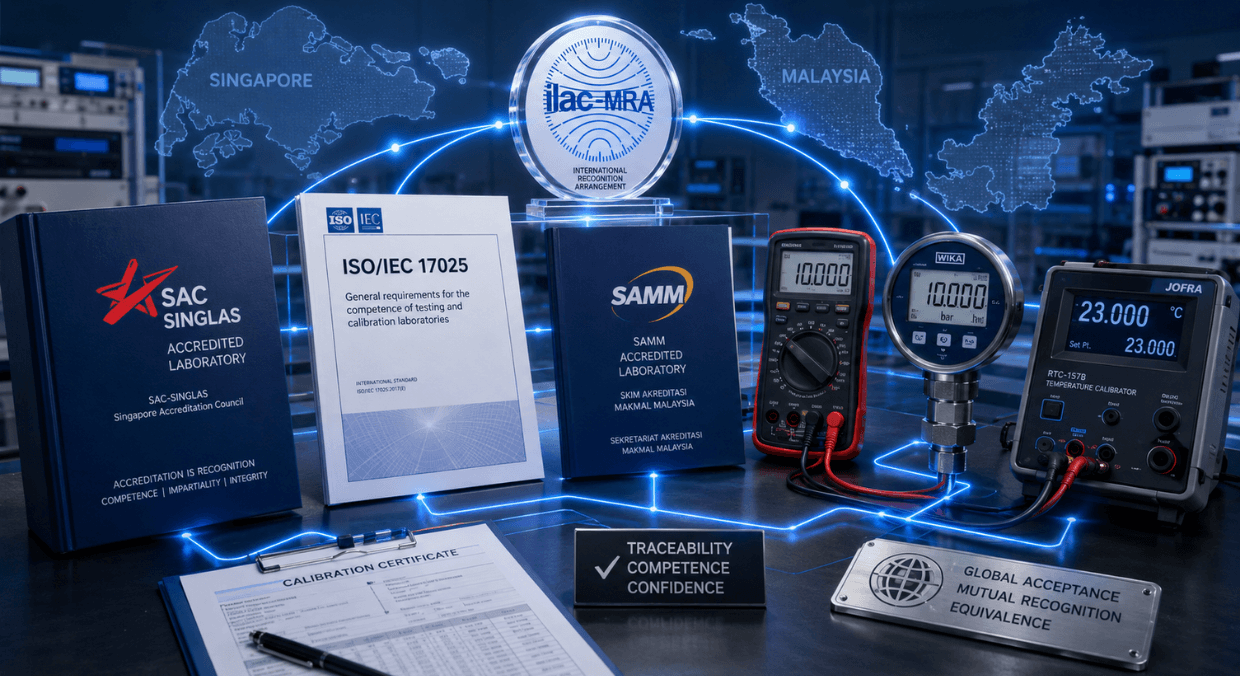
ISO/IEC 17025 is the global standard for calibration and testing laboratory competence, covering management systems, technical competence, and measurement traceability. However, the standard alone does not determine cross-border acceptance. What matters is which body assessed the laboratory against that standard, and whether that body is recognised by the authority you need to satisfy.
The ILAC MRA: The International Framework That Links Singapore and Malaysian Accreditation
What ILAC MRA Membership Means for a Calibration Certificate
The ILAC Mutual Recognition Arrangement is the global cooperative through which national accreditation bodies agree to recognise each other’s assessments. When a laboratory’s certificate carries the ILAC MRA logo, it signals that the issuing facility has been assessed against ISO/IEC 17025 by an accreditation body that is a full signatory. The traceability chain and technical competence requirements have been independently verified to an internationally accepted standard.
Why ILAC MRA Recognition Does Not Automatically Mean All Malaysian Authorities Will Accept It
The ILAC MRA is a framework for mutual recognition between accreditation bodies, not a binding instruction to every national regulatory authority. Local regulators and major clients retain the right to specify which accreditation bodies they will accept in their particular requirements. The same certificate may be accepted in one context and rejected in another within the same facility.
SAC-SINGLAS: Singapore’s Calibration Accreditation Body and Its ILAC MRA Status
The Singapore Accreditation Council (SAC) administers SINGLAS, Singapore’s laboratory accreditation programme. SAC is a full ILAC MRA signatory, which means SINGLAS-accredited certificates carry internationally recognised standing. When verifying a Singapore facility, check the SAC online directory for current accreditation status and, critically, the specific measurement parameters and instrument categories covered in the scope. A certificate issued outside the laboratory’s accredited scope does not carry ILAC MRA standing.
SAMM: Malaysia’s Calibration Accreditation Programme Under DSM
SAMM (Skim Akreditasi Makmal Malaysia) is Malaysia’s national laboratory accreditation programme administered by the Department of Standards Malaysia (DSM). DSM is also a full ILAC MRA signatory, so SAMM-accredited certificates carry the same international standing as SINGLAS in contexts that accept any ILAC MRA member. Where authorities specifically require SAMM, the reason is typically contractual specification, domestic regulatory policy, or national preference in certain sectors, not a technical dispute with SINGLAS quality.
Where Singapore Calibration Certificates Are Generally Accepted in Malaysia
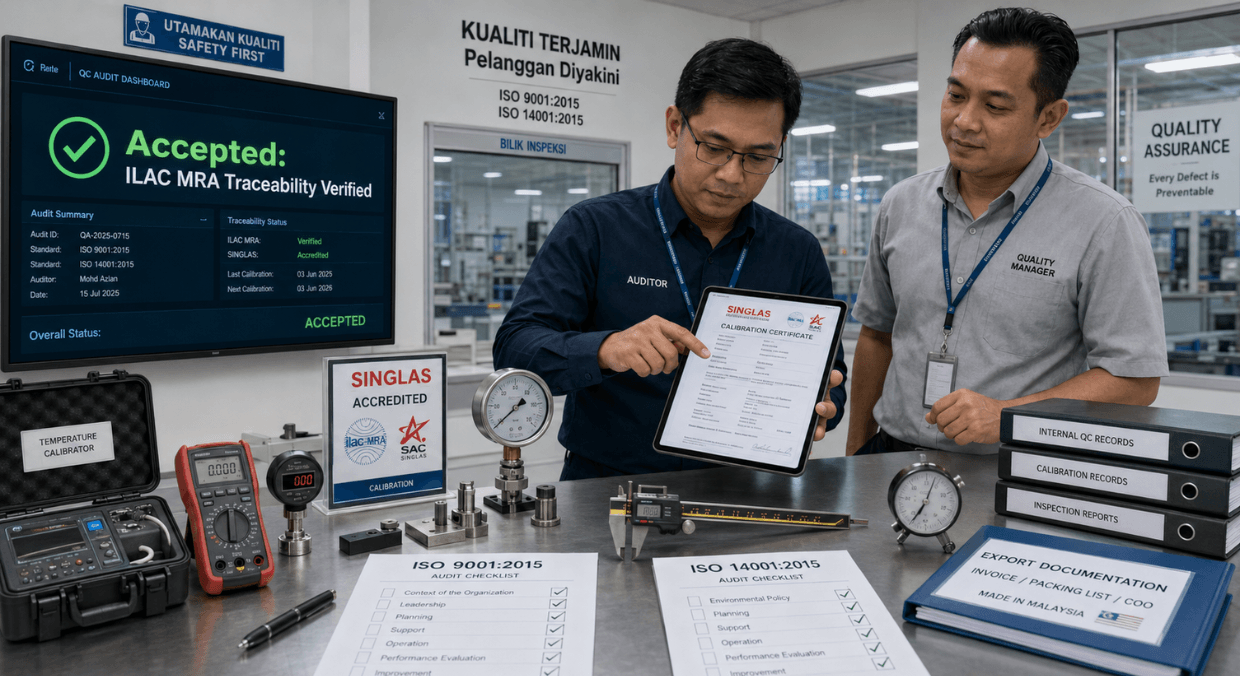
ISO 9001, ISO 14001, and General Quality Management System Audits
ISO management system audits verify that measuring equipment is measured against traceable standards. They do not typically specify which national accreditation body issued the certificate. SINGLAS-accredited certificates are generally accepted in ISO 9001 and ISO 14001 audits conducted in Malaysia because the ILAC MRA traceability chain satisfies the standard’s requirements. The exception is when a customer-specific requirement in a client’s quality plan overrides this.
International Trade and Export Documentation Requirements
Certificates for instruments used in export processes are typically assessed against ILAC MRA recognition. Singapore calibration certificates often satisfy the documentation requirements Malaysian exporters face in international trade contexts.
Internal Quality Control and Manufacturer Calibration Records
When testing is performed for internal process control rather than regulatory submission, Singapore laboratory certificates are generally accepted because no external regulatory authority specifies accreditation requirements. The certificate must still demonstrate SI-traceable measurement and state measurement uncertainty to be technically credible.
What the ILAC MRA CMC Scope Means for Measurement Traceability Claims
A laboratory’s Calibration and Measurement Capabilities (CMC) scope lists the specific measurement ranges and uncertainties it is accredited to certify. Confirming that the instruments being assessed fall within the laboratory’s CMC scope is essential. A certificate issued outside this scope does not carry ILAC MRA standing regardless of the laboratory’s general accreditation status.
Where Singapore Calibration Certificates May Not Be Sufficient in Malaysia
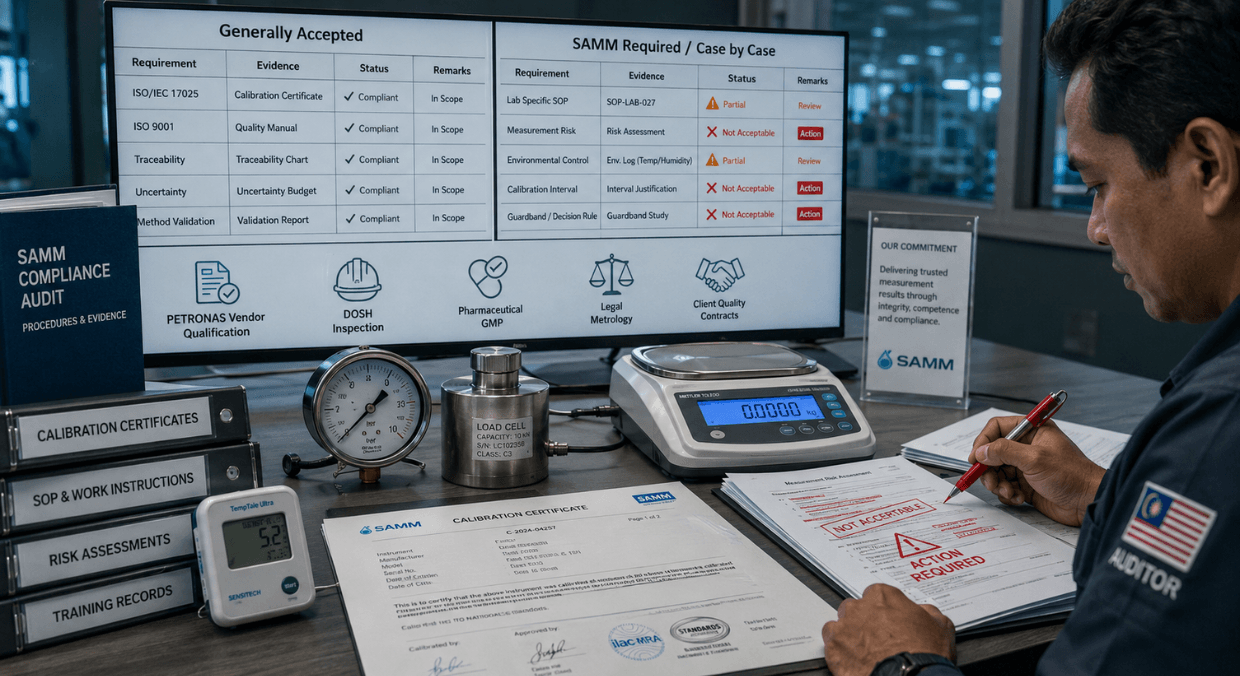
The table below summarises how SINGLAS acceptance varies across key Malaysian contexts.
Malaysian Context | SINGLAS Generally Accepted | SAMM or Specific Approval May Be Required |
ISO 9001 / 14001 audits | Yes | Only if client-specified |
International trade documentation | Yes | Rarely |
Internal QC records | Yes | No |
PETRONAS vendor qualification | Case by case | Often required in specification |
DOSH statutory inspections | Sometimes | For specific instrument categories |
Pharmaceutical GMP / NPRA | Case by case | Frequently required |
Legal metrology / domestic trade | No | Always required |
Client-specified quality contracts | Case by case | When contractually stated |
PETRONAS Vendor Qualification and Contractor Calibration Requirements
PETRONAS and major oil and gas operators specify calibration requirements through their vendor qualification and contractor management systems. These specifications sometimes require SAMM-accredited work rather than accepting any ILAC MRA member. Verify the specific documentation requirements in the PETRONAS vendor qualification package before sending instruments to a Singapore facility for work that will be submitted in this context.
DOSH (Department of Occupational Safety and Health) Statutory Inspections
Pressure vessels, lifting equipment load cells, and safety-critical instruments subject to DOSH statutory inspection may fall under specific recognition requirements that go beyond general ILAC MRA acceptance. Verify what DOSH accepts for the specific instrument category before the work is performed.
Pharmaceutical GMP and NPRA-Related Calibration Documentation
GMP compliance under Malaysia’s National Pharmaceutical Regulatory Agency (NPRA) approaches laboratory requirements carefully. Assuming that pharmaceutical contexts mirror general quality management acceptance is one of the most consistently made mistakes in this sector. Confirm with your GMP auditor or the NPRA requirement documentation before using a Singapore facility for instruments in a pharmaceutical manufacturing or distribution context.
Utilities and Metrological Legal Instruments Under Trade Authority Jurisdiction
Instruments classified as legal metrology instruments in Malaysia require calibration or verification by specifically approved bodies regardless of a laboratory’s ILAC MRA status. Trade measurement equipment, utilities metering, and weighing instruments used in commercial transactions all fall within this framework. No ILAC MRA certificate, including SINGLAS, substitutes for the required approved verification in this category. Note: Verify the current responsible ministry name against Malaysia’s active government structure before referencing it in formal documentation.
When a Malaysian Client’s Internal Audit Specification Requires SAMM
Client purchase orders or quality plans in oil and gas procurement, government project documentation, and major local manufacturing contracts frequently specify SAMM-accredited work even when the regulatory minimum does not require it. When a client’s quality specification requires SAMM, it requires SAMM. Verify before instruments are sent.
How to Verify Whether a Singapore Lab’s Certificate Will Be Accepted for Your Specific Use
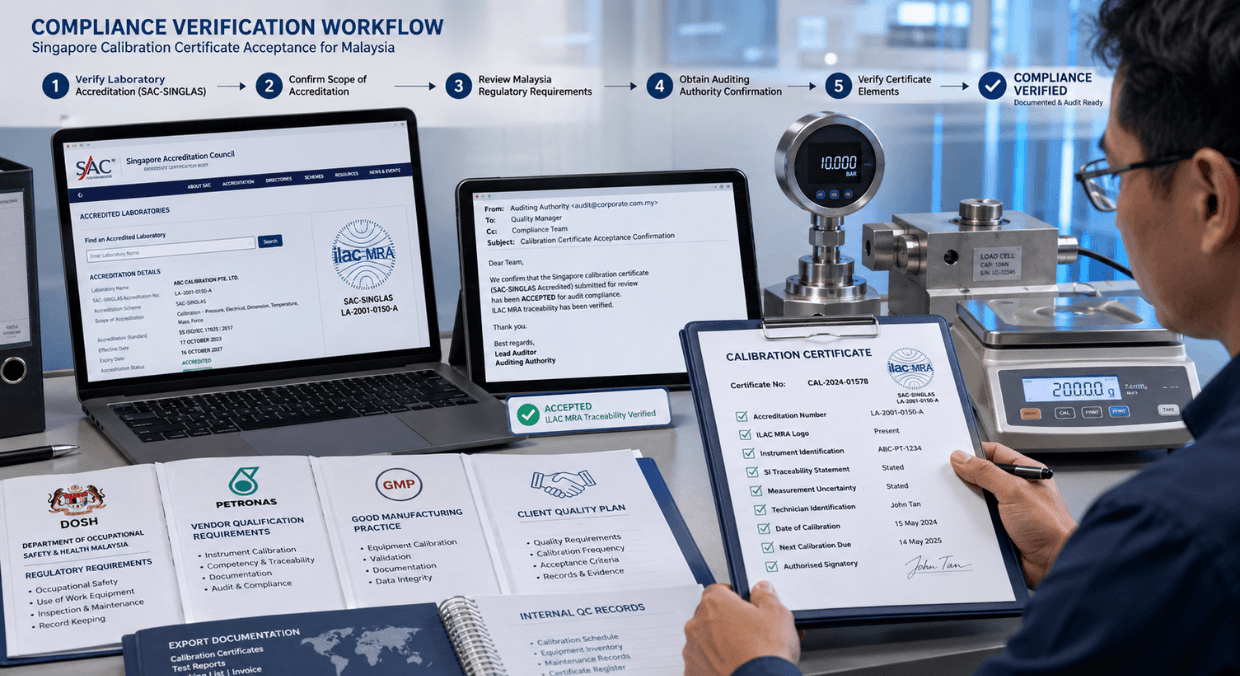
Step 1: Check the Laboratory’s Accreditation Scope on SAC’s Online Registry
Access the SAC online directory and confirm that the specific instrument categories and measurement parameters you need are covered in the laboratory’s current SINGLAS accreditation scope. General accreditation status without scope confirmation is insufficient.
Step 2: Identify the Specific Malaysian Regulatory Requirement for Your Context
Find the requirements in your specific regulatory or contractual context: the DOSH guideline, the PETRONAS vendor documentation, the GMP guideline, or the client quality plan. This step cannot be skipped. The same facility may be acceptable for one application and unacceptable for another in the same building.
Step 3: Confirm With the Auditing Authority Before Sending Instruments
Ask the auditing authority or client directly whether they accept ILAC MRA member certificates from outside Malaysia, or whether they require SAMM. Document this confirmation before any instruments leave the facility.
What a Compliant Calibration Certificate Must Include to Support Cross-Border Recognition
Once acceptance is confirmed, the certificate itself must meet minimum content requirements to support cross-border recognition. It must contain: laboratory name and accreditation number, ILAC MRA logo if applicable, instrument identification, date, traceability statement to SI units, measurement results with stated uncertainty, and the technician’s identification. A certificate missing any of these elements may be rejected regardless of the laboratory’s accreditation status.
Atlantic Services Malaysia is one example of a SAMM-accredited calibration laboratory operating in Malaysia that serves clients whose compliance context, regulatory authority, or contractual requirements specify domestic Malaysian laboratory accreditation rather than accepting any ILAC MRA member certificate.
Conclusion
Singapore calibration laboratory certificates are generally valid in Malaysia for ISO quality management audits and international trade documentation through the ILAC MRA framework. However, this acceptance is not universal. PETRONAS vendor qualification, DOSH statutory instruments, pharmaceutical GMP compliance, legal metrology, and client-specified quality requirements all represent contexts where domestic SAMM accreditation or specific authority approval is frequently required. The three steps that prevent certificate rejection are: verifying the laboratory’s accreditation scope on the SAC registry, identifying the specific Malaysian requirement for the application, and confirming acceptance with the auditing authority before instruments are sent. The distinction between “technically valid through ILAC MRA” and “regulatorily accepted by this specific Malaysian authority” is the single most important concept for any Malaysian operator choosing between a Singapore and a Malaysia-based calibration facility.