

The Calibration Gap Most Malaysian Facilities Don’t Know They Have

Why Partial Calibration Programmes Fail Full-Scope Audits
ISO 9001 Clause 7.1.5 — The Requirement to Calibrate All Measurement Equipment Affecting Product Conformity
The clause is deliberately broad. It does not specify instrument types. It covers any equipment used to provide evidence of product or process conformity — including instruments your team considers peripheral: the oven thermometer used during heat treatment, the clamp meter used to verify electrical continuity before sign-off, the pressure gauge mounted on a test rig that has been in service for six years without a calibration record.
Auditors are trained to find these gaps. The instrument register is typically one of the first documents an auditor requests during an ISO 9001 surveillance visit.
Common Omissions — What Usually Gets Missed
The most consistently overlooked instruments in Malaysian manufacturing and industrial facilities are pressure gauges treated as visual indicators rather than measurement devices, environmental monitoring thermometers assumed to be non-critical, and electrical instruments used for maintenance checks rather than product testing. None of these assumptions hold under formal audit scrutiny.
The Multi-Vendor Problem — Using Different Labs for Different Instruments
Many facilities solve the instrument-breadth problem by using multiple calibration vendors — one for dimensional instruments, another for electrical, a third for temperature. This appears logical but creates two specific compliance risks.
Traceability Inconsistencies Across Vendors
Each lab traces its reference standards to a national metrology institute — but not always the same one, and not always documented consistently. When an auditor reviews certificates from three different labs and finds different traceability chains with no documented equivalence, it raises questions that require investigation to resolve.
Certificate Format Mismatches That Confuse Auditors
Different labs use different certificate formats. Some include expanded uncertainty; some do not. Some reference [LINK: ILAC MRA → https://ilac.org/ilac-mra-and-signatories/]; some reference only their local accreditation scheme. When a facility’s calibration records look inconsistent across vendors, an auditor’s confidence in the overall programme drops — regardless of whether each individual certificate is technically valid.
What a Fully Covered Instrument Calibration Programme Looks Like
A complete programme maps every instrument that influences a measurement decision to a calibration schedule, a designated provider, a documented traceability chain, and a record-keeping system that survives staff turnover. The starting point is always a complete instrument register — a live document that reflects the actual state of the facility, not one started and abandoned during the last audit cycle.
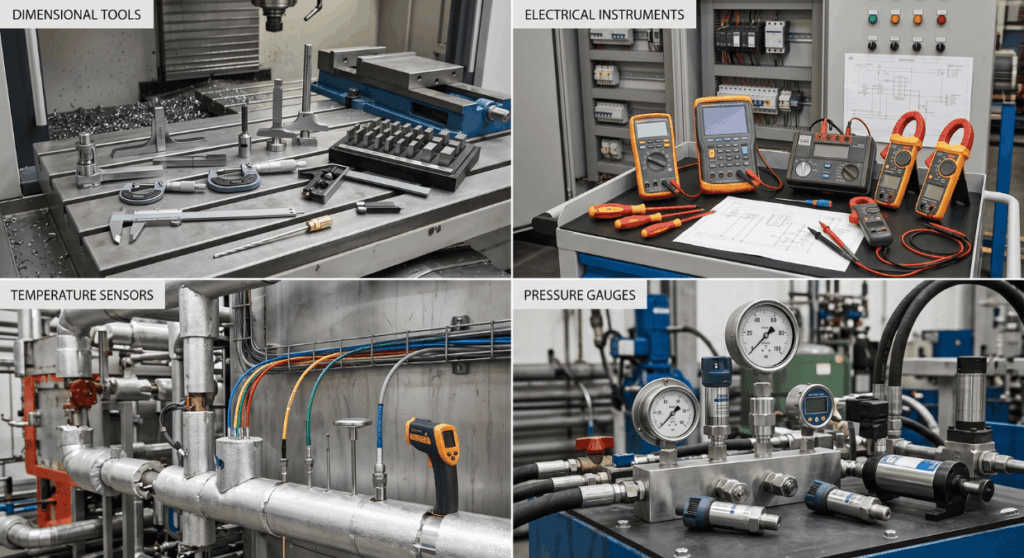
The Four Major Instrument Categories in Industrial Calibration
Dimensional Instruments — Measuring Length, Geometry, and Form
Calipers, Micrometers, Dial Gauges, Height Gauges, Go/No-Go Gauges
Dimensional instruments are the most commonly calibrated category in manufacturing. A micrometer reading off by 0.02mm may be acceptable in one application and a cause for rejection in another, depending on the tolerance specification.
Typical Measurement Uncertainty Ranges and Why They Matter for Tight-Tolerance Manufacturing
The calibration certificate for a dimensional instrument must state the measurement uncertainty — the range within which the true value is expected to fall, at a defined confidence level. For tight-tolerance work, the calibration uncertainty must be demonstrably smaller than the product tolerance. If the calibration uncertainty is larger than the acceptance tolerance, the calibration result is meaningless for conformity determination.
What Is the Difference Between Oven Validation and Thermometer Calibration?
Dimensional calibration is temperature-sensitive. Most formal calibration laboratories maintain a controlled environment of [LINK: 20°C ±1°C per ISO 1 → https://www.iso.org/standard/66760.html] — the reference temperature for geometric measurements. Instruments brought in from a hot factory floor must stabilise before calibration begins. Facilities calibrating in-house without temperature control are introducing systematic errors they cannot quantify.
Electrical Instruments — Measuring Voltage, Resistance, Current, and Insulation
Multimeters, Clamp Meters, Insulation Resistance Testers, Power Supplies, Oscilloscopes
Electrical instruments are critical in O&G, utilities, electronics manufacturing, and any facility where electrical safety or product electrical performance is tested before shipment. They drift over time — insulation resistance testers are among the most frequently found out-of-tolerance instruments in routine calibration programmes.
Industries with the Highest Electrical Instrument Calibration Frequency
Oil and gas facilities require electrical instrument calibration as part of their hazardous area equipment maintenance schedules. Electronics manufacturers require tight calibration of power supplies and test equipment for specification compliance. Utilities calibrate metering equipment under statutory requirements enforced by the [LINK: Energy Commission of Malaysia → https://www.st.gov.my].
Common Calibration Failures in Electrical Instruments and What Causes Them
Battery-powered instruments drift faster than mains-powered ones, particularly in high-humidity environments. Insulation testers used in the field accumulate mechanical wear that affects contact resistance readings. Clamp meters exposed to strong magnetic fields develop offset errors. These are consistent findings in routine calibration returns, not theoretical risks.
Temperature Instruments — Measuring Heat, Environment, and Process Conditions
Thermometers, RTDs, Thermocouples, Data Loggers, Environmental Chambers, Industrial Ovens, Freezers
Temperature is the most measurement-intensive parameter in pharmaceutical manufacturing, food production, and any process where heat treatment affects product properties.
Pharmaceutical Cold Chain and GMP Implications
Good Manufacturing Practice regulations — enforced in Malaysia under the [LINK: National Pharmaceutical Regulatory Agency → https://www.npra.gov.my] — require that temperature instruments used in production, storage, and distribution are calibrated at defined intervals, with records maintained and available for inspection. The consequences of non-compliance extend beyond audit findings to product recalls and batch rejections.
What Is the Difference Between Oven Validation and Thermometer Calibration?
Calibrating a thermometer establishes its accuracy at defined measurement points. Validating an oven establishes that the chamber maintains uniform temperature across its working volume — requiring multiple calibrated sensors at defined positions, governed by a separate protocol. A calibrated thermometer is a prerequisite for a valid oven qualification, not a substitute for it.
Pressure and Mechanical Instruments — Measuring Force, Pressure, and Torque
Pressure Gauges, Test Gauges, Deadweight Testers, Torque Wrenches, Force Transducers, Load Cells
Pressure instruments are the most safety-critical category in oil and gas, marine, and process manufacturing. A pressure gauge that reads low on a high-pressure system is not an inconvenience — it is a hazard.
O&G and Marine Calibration Requirements — Safety-Critical Context
In oil and gas operations, pressure instruments are subject to more frequent calibration intervals than equivalent instruments in manufacturing, reflecting consequence severity. Marine classification societies — including [LINK: Bureau Veritas → https://www.bureauveritas.com], Lloyd’s Register, and DNV — specify calibration requirements for pressure and temperature instruments aboard vessels as part of statutory survey obligations.
The Role of Torque Calibration in Structural and Mechanical Assembly Compliance
A torque wrench delivering 15% more torque than indicated can cause fastener failure in precision assemblies. One delivering less risks loose joints. Neither failure mode is immediately visible — both become apparent under load, in service, or during a failure investigation. Calibrated torque instruments are specified in [LINK: ISO 6789 → https://www.iso.org/standard/72827.html], and their use is increasingly audited in quality plans for structural and mechanical applications.
Lab Calibration vs. On-Site Calibration — Choosing the Right Delivery Model
Factor | Lab Calibration | On-Site Calibration |
Environment control | Controlled temperature, humidity, vibration | Subject to site conditions — requires active management |
Measurement uncertainty | Generally lower — reference conditions optimised | Typically higher — site variables increase uncertainty |
Best for | Small, portable instruments; tight-tolerance work | Fixed plant, large chambers, in-situ pressure systems |
Turnaround impact | Equipment removed from service during calibration | Equipment remains in place — minimal production downtime |
Logistics | Transport risk for delicate instruments | Mobilisation cost for provider to bring reference standards |
Certificate validity | Full accredited scope if within lab’s ILAC MRA scope | Accredited only if lab’s scope explicitly covers on-site work |
Traceability | Established lab reference chain | Portable references must be independently traceable |
What Lab Calibration Involves — The Controlled Environment Advantage

A calibration laboratory maintains environmental conditions — temperature, humidity, and vibration isolation — that minimise external contributions to measurement uncertainty. Reference standards are held on-site, regularly calibrated against national standards, and their uncertainty contributions formally included in every certificate issued.
What On-Site Calibration Involves — And When It Is the Only Viable Option
Fixed Equipment
Large industrial ovens, autoclave chambers, and installed pipeline systems cannot be transported to a laboratory. On-site calibration is the only compliant option, requiring the provider to bring portable reference standards that are themselves traceable — and to document site conditions during calibration, since these affect measurement uncertainty.
Marine and Offshore
Instruments aboard vessels must be calibrated on board or replaced on schedule. A vessel in port for scheduled maintenance typically has a narrow window for calibration to be completed before departure, making a provider with genuine on-site capability critical to schedule compliance.
O&G Field Instruments
Flow meters, level transmitters, and pressure transmitters installed in process vessels are calibrated in-situ using portable calibrators connected to the instrument’s signal loop. This is a specialised capability — not all labs that offer on-site calibration have the reference equipment or trained personnel to perform loop calibration on installed transmitters.
The Trade-Offs Between Lab and On-Site Calibration
Measurement Uncertainty Differences
On-site calibration generally yields higher measurement uncertainty than lab calibration for the same instrument type, because site conditions contribute to the measurement. A well-managed on-site calibration quantifies and documents these contributions. A poorly managed one ignores them — producing a certificate that looks complete but understates the true uncertainty.
Turnaround Time, Logistics, and Downtime Implications
Removing instruments from service for lab calibration creates downtime. On-site calibration avoids this but introduces mobilisation lead time and scheduling dependencies. For facilities with large instrument populations, a planned campaign combining both approaches — sending portable instruments to the lab and scheduling on-site visits for fixed equipment — is usually the most efficient model.
When a Hybrid Approach Makes Sense
A hybrid model works well when a facility has both portable instruments (calipers, multimeters, handheld pressure gauges) that can be efficiently batched and sent to a laboratory, and fixed equipment (ovens, installed pressure systems, vessel instruments) that require on-site service. Managing both under a single accredited provider eliminates the traceability inconsistency risk described in the opening section.
What to Ask a Calibration Provider About Their On-Site Capability
Reference Equipment Portability and Traceability
Ask for the calibration certificates of the reference standards the provider intends to use on-site. These should be current, issued by an accredited laboratory, and cover the measurement range relevant to your equipment.
Environmental Controls During On-Site Calibration
Ask what the provider does when site conditions fall outside acceptable limits — temperature too high, excessive vibration, electromagnetic interference. A credible provider will have documented procedures. A provider without an answer to this question should not be performing on-site calibration for audit-critical instruments.
Documentation — Does the On-Site Certificate Match the Accreditation Scope?
A lab may be accredited for pressure calibration in its laboratory but not for on-site pressure calibration. If the certificate issued after an on-site visit carries the accreditation logo but the work was performed outside the lab’s accredited scope, the certificate is not accredited — regardless of how it appears on paper. Always verify this before the work is done, not after.
How Accreditation Scope Works at the Instrument Level

Why a Lab’s ISO 17025 Accreditation Does Not Cover All Instruments Automatically
Accreditation Scope Certificates — How to Read Them
Every [LINK: ISO/IEC 17025-accredited laboratory → https://www.iso.org/ISO-IEC-17025-testing-and-calibration-laboratories.html] holds a scope of accreditation — a document listing the specific measurands, instrument types, measurement ranges, and associated uncertainty levels the lab is authorised to calibrate under its accreditation. Work performed outside this scope is not accredited work, regardless of the lab’s overall status.
Measurands, Ranges, and Measurement Uncertainty Listed by Instrument Type
A scope certificate is organised by measurand — length, electrical resistance, temperature, pressure — and within each, by specific range and achievable uncertainty. A lab accredited for dimensional calibration down to 0.001mm is not automatically accredited for work at 0.0001mm. The range matters, not just the category.
The Risk of Calibrating Outside a Lab’s Accredited Scope
Out-of-Scope Calibration Is Not Invalid — But It Is Not Accredited
A lab can perform calibration work outside its accredited scope, and the work may still be technically competent. But the certificate issued cannot carry the accreditation body logo or be presented as accredited calibration. If you are using these certificates as audit evidence, you are presenting non-accredited records as though they were accredited — a finding waiting to happen.
How Auditors Identify Scope Mismatches on Calibration Certificates
An experienced auditor will ask to see the lab’s scope certificate and cross-reference it against your calibration records. If your pressure gauge certificate carries the SAC-SINGLAS logo but pressure calibration does not appear in the lab’s scope, the certificate will be rejected. This scenario is more common than most QA managers expect.
Verifying a Lab’s Scope for Your Specific Instrument Mix
SAMM and SAC-SINGLAS Online Scope Registries — How to Use Them
Before committing to any calibration provider, pull their scope certificate directly from the [LINK: SAMM registry → https://www.jsm.gov.my] or [LINK: SAC-SINGLAS registry → https://www.sac-accreditation.gov.sg/resources/find-accredited-organisations] — not from their website, which may not reflect the current accredited scope — and compare it line by line against your instrument register. Atlantic Services, accredited under SAC-SINGLAS, is an example of a lab whose scope can be independently verified on the SAC registry before any engagement.
Questions to Ask Before Sending Instruments for Calibration
Ask specifically: “Is [instrument type] within your accredited scope for the range [X to Y]?” A lab that cannot answer this question precisely, or says yes without referencing its scope certificate, should prompt further verification before you proceed.
What Happens When Your Instrument Type Falls Outside Any Accredited Scope in Malaysia
Manufacturer Calibration vs. Third-Party Accredited Calibration
Some highly specialised instruments may not yet be covered by any accredited lab in Malaysia. In these cases, manufacturer calibration with a stated traceability chain may be the best available option. Document this in your quality management system with an explanation of why accredited calibration was not obtainable — rather than treating it as equivalent to accredited calibration.
Building a Calibration Management Programme for Malaysian Industrial Facilities

Step 1 — Creating a Complete Instrument Register
What to Capture
A usable register includes: unique instrument ID, instrument type, physical location, measurement range, calibration interval, assigned lab, last calibration date, certificate number, and next due date. Every instrument that influences a measurement decision belongs here.
Common Gaps in Existing Registers
The most common gap is instruments acquired after the register was last comprehensively reviewed — purchased for a project, used routinely since, and never formally added to the calibration schedule. A physical walkthrough of the facility comparing installed instruments against the register typically surfaces five to fifteen unregistered instruments in a mid-sized manufacturing operation.
Step 2 — Assigning Calibration Intervals Based on Instrument Criticality
The ISO 17025 Principle — Intervals Should Be Justified, Not Defaulted
[LINK: ISO/IEC 17025:2017 → https://www.iso.org/standard/66912.html] expects calibration intervals to be determined based on evidence — the instrument’s historical stability, usage intensity, environmental exposure, and the consequence of measurement error. An interval of twelve months adopted by default, with no documented justification, will not satisfy an auditor asking why that interval was chosen.
Risk-Based Interval Assignment
Sort instruments into three tiers: critical (directly affecting product conformity or safety — calibrate most frequently), important (process monitoring where drift could go undetected — calibrate at standard intervals), and reference (used infrequently, stored under controlled conditions — calibrate less frequently with documented justification).
Step 3 — Matching Instruments to the Right Lab and Delivery Model
Single-Vendor vs. Multi-Vendor — Compliance and Logistics Implications
Where a single provider can cover your full instrument mix, use one. The benefits — consistent certificate format, unified traceability chain, and a single audit contact — are practical, not theoretical. Where a single provider cannot cover the full scope, document the rationale for each vendor clearly and ensure their respective traceability chains are independently verifiable.
Audit Trail Continuity — Why Changing Labs Mid-Cycle Creates Risk
Switching calibration providers between calibration events for the same instrument creates a gap in traceability continuity. Auditors may ask whether the new lab’s reference standards are traceable to the same national standard as the previous provider, and whether any systematic offset was identified during the transition. This requires documentation most facilities do not prepare.
Step 4 — Managing Calibration Records for Audit Readiness
Certificate Filing and Retrieval
Calibration records must be retrievable on demand during an audit. A paper-based system requiring sorting through filing cabinets to locate a specific certificate is not a records system — it is an audit risk. Digital records indexed by instrument ID and calibration date are the minimum standard for any externally audited facility.
What Auditors Look For in a Calibration Record System
Auditors verify that every instrument in the register holds a current, valid certificate; that each certificate was issued within the accredited scope; that the calibration interval has not been exceeded; and that any out-of-tolerance findings have been addressed with documented corrective action.
Handling Out-of-Tolerance Findings — Corrective Action Documentation Requirements
When an instrument returns out of tolerance — and it will, eventually — the compliance obligation does not end with repair and recalibration. The harder question is what happened to all the products measured with that instrument while it was drifting. A pressure gauge found to be 8% high on return from service was presumably 8% high during every reading taken in the months since its last calibration. Someone has to assess whether any of those readings led to a product acceptance decision that should now be reviewed. That assessment must be documented. Most facilities skip this step entirely — and most auditors who find the out-of-tolerance certificate then ask for evidence that the impact assessment was performed.