
The Legal Framework: Which Regulations Create Calibration Obligations
OSHA 1994 (Act 514) and the New OSH Amendment Act 2022
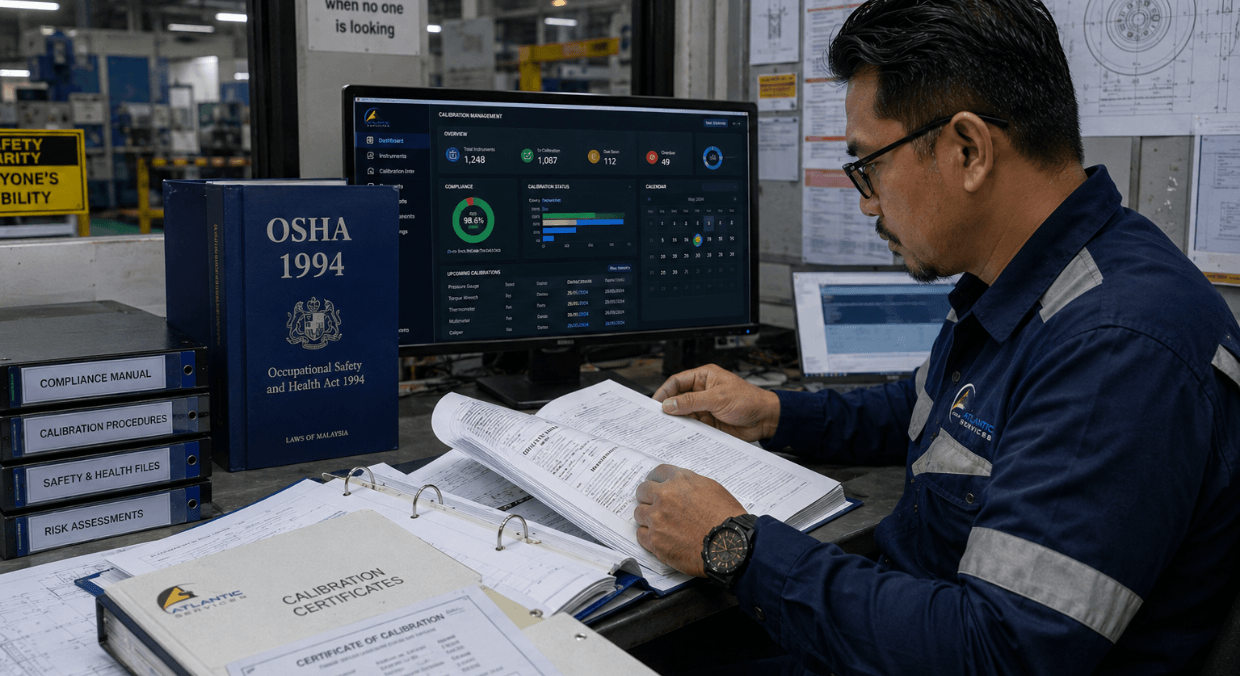
The Occupational Safety and Health Act 1994 (Act 514) requires employers to ensure that all plant, machinery, and systems of work are safe. Safety-critical measuring instruments used to monitor and control hazardous plant are part of this obligation. The OSH Amendment Act 2022 tightened enforcement significantly, with fines for serious violations now reaching up to RM500,000. The key principle is that an employer who operates safety-critical plant with instruments that cannot demonstrate calibration traceability is exposed under OSHA even where no specific regulation names calibration explicitly.
The Factories and Machinery Act 1967 (FMA) and Its Replacement by P.U.(A) 99/2024
The FMA 1967 (Act 139) established the Certificate of Fitness system for boilers, pressure vessels, lifting equipment, and other machinery. Many factory managers still reference the FMA when discussing the compliance framework. As of 1 June 2024, the Occupational Safety and Health (Plant Requiring Certificate of Fitness) Regulations 2024, gazetted as P.U.(A) 99/2024, replaced key FMA provisions. The Certificate of Fitness requirement is maintained under P.U.(A) 99/2024, and so are the calibration obligations associated with registered plant. Referencing the FMA as your compliance framework post-June 2024 is no longer accurate. See DOSH Malaysia for current regulatory documentation.
DOSH Industry Code of Practice (ICOP) 2010 for Confined Space Entry
DOSH’s Industry Code of Practice on Occupational Safety and Health for Confined Space Entry (2010) is one of the clearest direct calibration requirements in its own published guidance. It mandates that gas detectors used for atmospheric monitoring during confined space entry must be calibrated and function-tested. Any Malaysian factory operating confined spaces, including tanks, vessels, pits, or enclosed plant rooms, must maintain calibration records for every gas detector used in those entry procedures. A bump test confirms the sensor responds. Only a full calibration against certified reference gas confirms that the concentration reading is accurate. The inspection process checks for calibration records, not bump test logs alone.
Which Instruments Are in DOSH Calibration Scope in a Malaysian Factory
Category 1: Pressure Measurement Instruments on Registered Pressure Vessels and Boilers
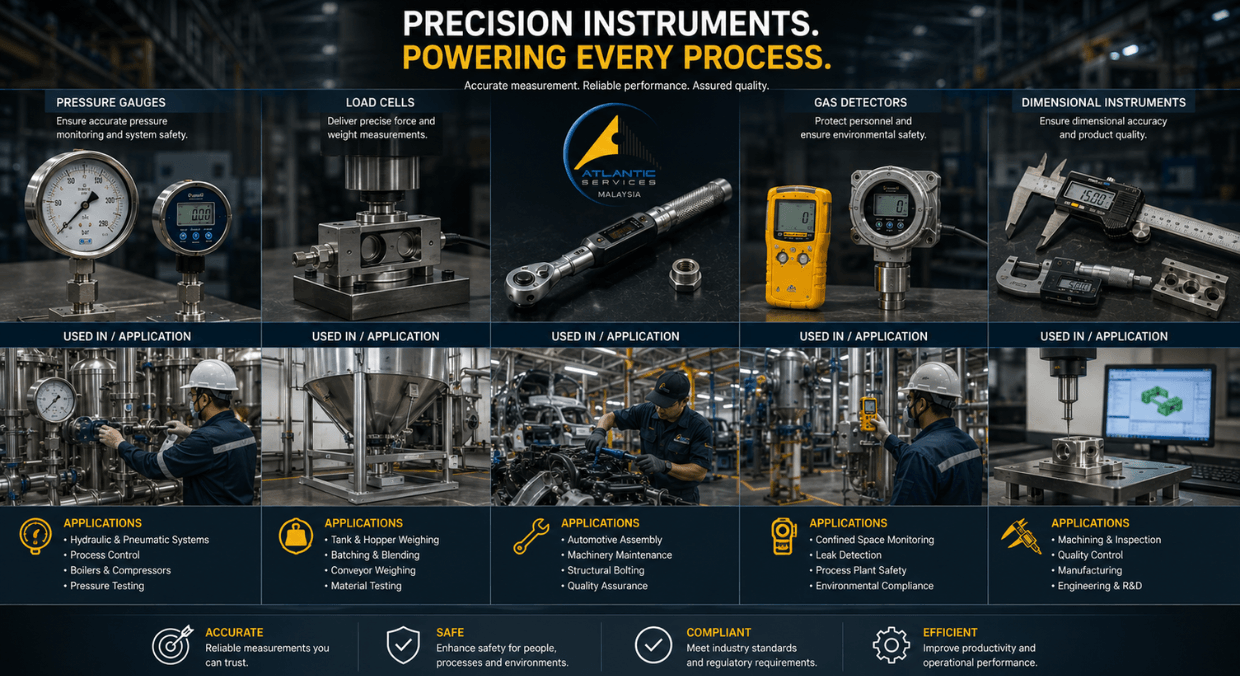
Pressure gauges, test gauges, and safety relief valve verification instruments on registered unfired pressure vessels and steam boilers are in scope by association with the plant they monitor. A pressure gauge that reads incorrectly means the operator cannot confirm safe operating pressure. Certificate of Fitness renewal inspections specifically examine whether gauges monitoring registered vessels hold current certificates from an accredited laboratory.
Category 2: Force and Load Measurement Instruments on Registered Lifting Equipment
Load cells, crane scales, dynamometers, and torque wrenches used for structural fasteners on registered lifting equipment all carry calibration obligations. Proof load testing, required before a Certificate of Fitness is issued for overhead cranes and hoists, uses load cells and reference force standards that must be calibrated and traceable. Torque wrenches used to install structural fasteners on registered lifting equipment must be calibrated to demonstrate that the specified torque was applied during installation.
Category 3: Gas Detection Instruments for Confined Space and Hazardous Area Work
Portable 4-gas monitors, fixed gas detection systems, and oxygen depletion monitors used in confined space entry are in direct scope under ICOP 2010. Every unit deployed for atmospheric monitoring must have a current certificate. A gas detector with an expired certificate cannot legally satisfy the DOSH ICOP requirement for confined space atmospheric monitoring, regardless of how recently a bump test was performed.
Two further categories create obligations in specific industries. Temperature instruments in factories processing hazardous materials are in scope where temperature control is a safety requirement. Electrical safety testing instruments used on registered electrical installations must also be calibrated to produce valid safety test results.
Additional Instruments That Create DOSH Calibration Obligations in Specific Industries
Equipment Category | Registered Plant | Instruments in Calibration Scope | Regulatory Basis |
Pressure systems | Unfired pressure vessels, steam boilers | Pressure gauges, test gauges, relief valve verification instruments | OSHA 1994, P.U.(A) 99/2024 |
Lifting systems | Overhead cranes, hoists, goods lifts | Load cells, crane scales, dynamometers, torque wrenches | OSHA 1994, P.U.(A) 99/2024 |
Confined space entry | All enclosed spaces per ICOP 2010 | Portable gas monitors, fixed detection systems, oxygen monitors | DOSH ICOP 2010 |
Electrical safety | Registered electrical installations | Insulation resistance testers, earth continuity testers | OSHA 1994 |
Hazardous fabrication | Pressure vessel manufacture or repair | Callipers, micrometres at critical dimensional checks | OSHA 1994 |
What a DOSH-Compliant Calibration Certificate Must Contain
The Minimum Documentation Requirements That DOSH Inspectors Look For
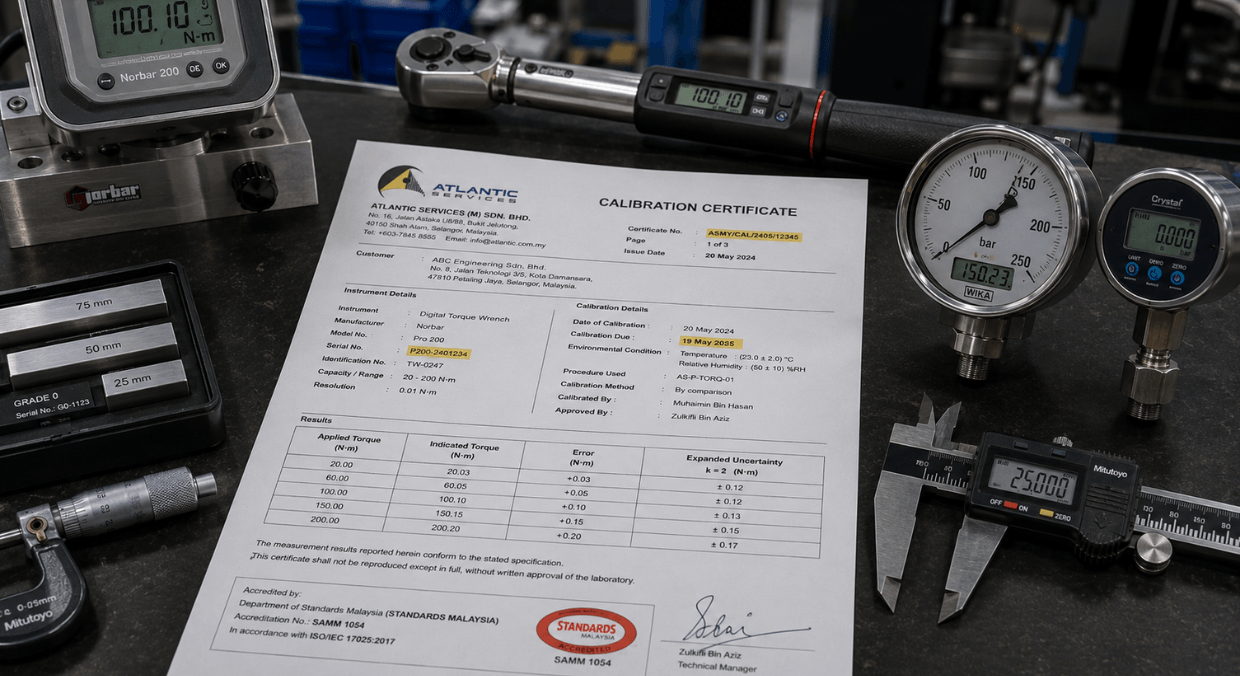
A certificate must contain five elements to satisfy a DOSH inspection. First, the instrument identity: make, model, and serial number. Second, the calibration date. Third, measurement results and uncertainty. Fourth, the accreditation status of the laboratory. Fifth, the due date or recommended next interval. Certificates from non-accredited laboratories carry significant risk: they cannot demonstrate that measurement results are traceable to national or international standards, which is what the inspection process specifically requires.
Does a SAC-SINGLAS Certificate Satisfy DOSH Requirements?
Yes, with a specific explanation of why. SAC-SINGLAS (the Singapore Accreditation Council’s accreditation scheme for calibration laboratories) is a signatory to the ILAC Mutual Recognition Arrangement. Malaysia’s DSM and SIRIM are also ILAC MRA signatories. Under the ILAC MRA framework, a SAC-SINGLAS certificate is technically equivalent to a SAMM-accredited certificate and is fully accepted by DOSH, SIRIM, and DSM auditors without requiring a separate Malaysian certificate.
For factory managers in Perak, Penang, Kedah, and the Northern Region, this means SAC-SINGLAS accredited laboratories provide fully DOSH-compliant certificates without requiring separate SAMM accreditation. One important check: confirm that the specific parameters tested fall within the laboratory’s declared SINGLAS scope of accreditation.
The MyKKP Platform and How Calibration Records Support Digital DOSH Compliance
MyKKP is DOSH’s official digital compliance management platform, used for CF applications, renewal submissions, and compliance record management. Certificates for instruments associated with registered plant may be required as supporting documentation during CF renewal submissions. Retain the records for a minimum of three to five years to provide continuous compliance evidence across multiple inspection cycles.
How to Conduct a DOSH Calibration Self-Audit Before an Inspection
Step 1: Map All DOSH-Registered Plant to Their Associated Measuring Instruments
Create a one-to-one mapping between each registered item and all measuring instruments monitoring or controlling its safe operation. An instrument does not need to be registered itself to be in scope. The pressure gauge on a registered vessel is in scope because the vessel is in scope. This mapping is the foundation of any credible self-audit.
Step 2: Check the Current Calibration Status of Every In-Scope Instrument
The most common inspection failure is an expired certificate that nobody checked. Compare every due date against today’s date before the inspector does. Any expired certificate means the instrument is non-compliant and must be submitted immediately. Also check forward: any certificate expiring within 90 days should be scheduled for renewal before the inspection date. An inspector who finds a certificate expiring in three weeks will raise it as a non-conformance.
Step 3: Verify That Every Certificate Is From an Accredited Laboratory
Check each certificate for the laboratory’s accreditation number and confirm the parameters tested fall within the declared scope. If any existing certificates are from non-accredited laboratories, they must be replaced. Schedule those instruments for recalibration at a SINGLAS or SAMM-accredited laboratory and obtain compliant certificates before the inspection.
Step 4: Compile Calibration Documentation Into a Ready-for-Inspection Format
Documentation format matters as much as documentation completeness. Prepare a register listing every in-scope instrument with its current certificate number, calibration date, and due date. File the full certificates by instrument or by equipment category. Include records of any corrective actions taken for instruments found out of tolerance at their last service. A factory manager who produces an organised compliance package immediately during an inspection signals systematic compliance rather than reactive compliance. That difference is visible to any experienced DOSH inspector.
How Atlantic Services Malaysia Supports Factory Managers Across Northern Malaysia with DOSH-Compliant Calibration
Atlantic Services Malaysia is a SAC-SINGLAS accredited calibration laboratory based in Ipoh that serves Northern Malaysian manufacturers requiring DOSH-compliant certificates for pressure gauges, torque wrenches, force transducers, and dimensional instruments associated with registered plant.
Conclusion
DOSH calibration requirements in Malaysia arise from the intersection of OSHA 1994 (Act 514), the OSH Plant Requiring Certificate of Fitness Regulations 2024 (P.U.(A) 99/2024, in force from June 2024), and DOSH’s ICOP 2010 guidance on confined space entry. Three equipment categories create the most common obligations: pressure gauges on registered pressure vessels and boilers, force and load instruments associated with lifting equipment, and gas detectors used in confined space atmospheric monitoring. Inspectors expect certificates from accredited laboratories with traceable results; SAC-SINGLAS certificates satisfy this requirement under the ILAC MRA framework. The four self-audit steps before any inspection are: map registered plant to associated instruments, check certificate currency, verify laboratory accreditation, and compile a ready-for-inspection documentation package. P.U.(A) 99/2024 is current law. The FMA 1967 provisions it replaced are no longer the reference point. Factory managers who have not reviewed their programme against the new framework since June 2024 should do so before their next inspection.