
Why Most Calibration Certificates Filed in Malaysian Facilities Are Incomplete
The Element Most Commonly Missing: Measurement Uncertainty
An auditor asks one question and the operator has no answer: “Where is the measurement uncertainty on this certificate?” The document shows measurement results, a due date, and the laboratory’s name. It does not state measurement uncertainty. Without it, the document cannot support a valid decision about whether the instrument is fit for its intended purpose. Filing it for two years does not make it complete when the auditor finds it.
Why a Service Record, Test Report, or Calibration Sticker Is Not a Calibration Certificate
A calibration sticker confirms that an instrument was serviced and has a next-due date. It confirms nothing else. A service report documents a maintenance activity. A test report documents functional performance. None of these is a calibration certificate.
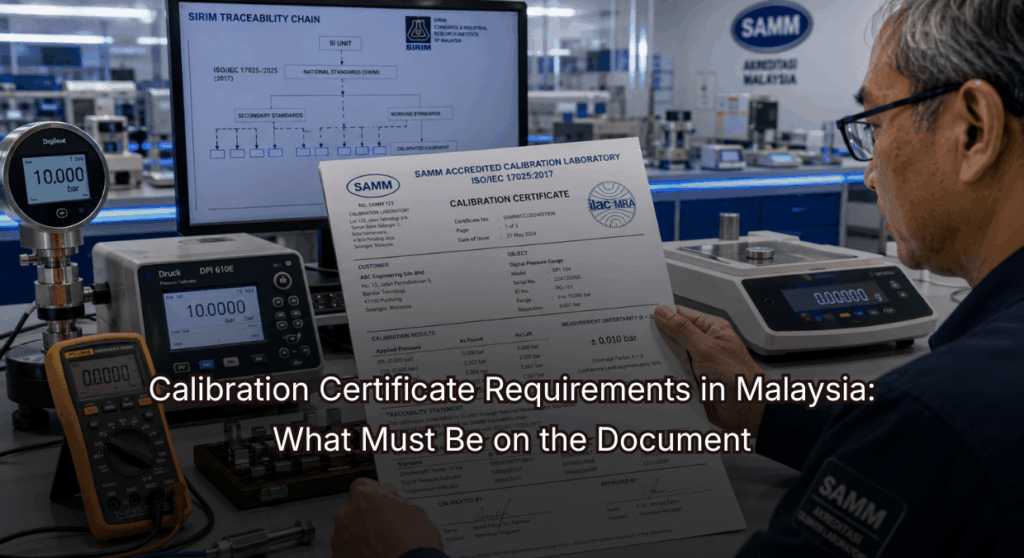
A calibration certificate is a metrological (relating to the science of measurement) document that records a measurement comparison between an instrument and a traceable reference standard, with stated uncertainty and a valid traceability chain. Operators who file service records as calibration certificates satisfy the paperwork obligation and fail the content assessment every time an auditor examines the document.
The Regulatory and Standards Basis for Calibration Certificate Requirements
What ISO/IEC 17025:2017 Requires From a Calibration Certificate
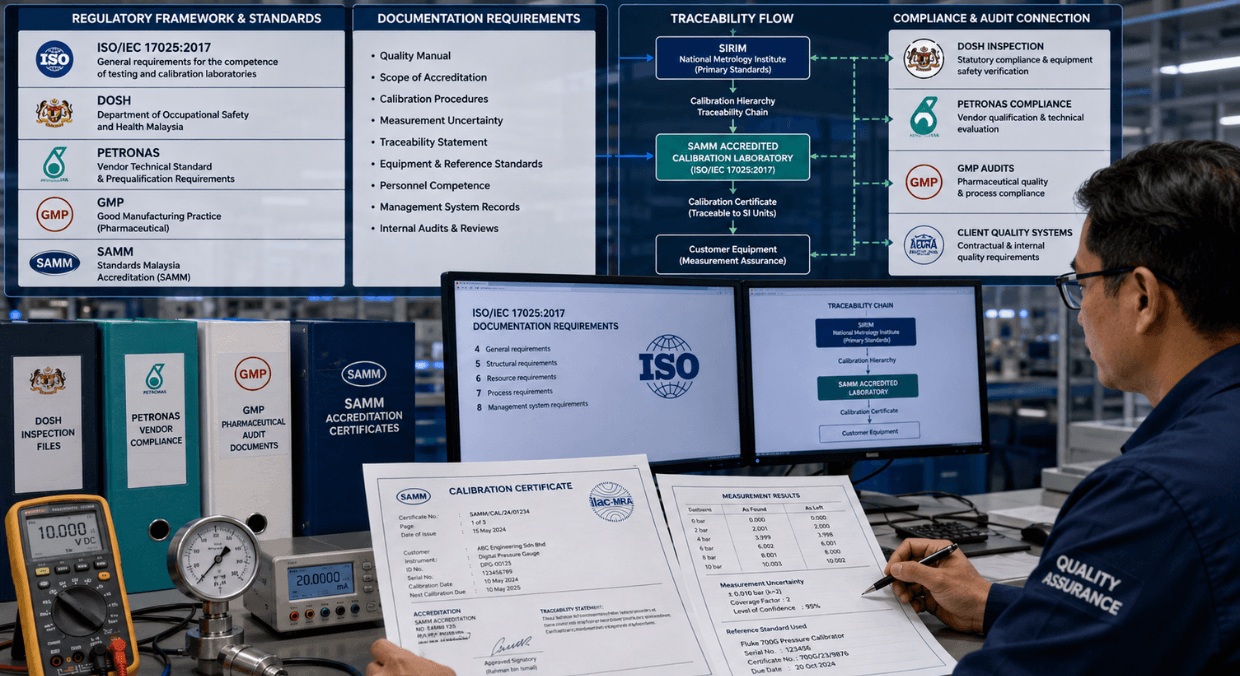
ISO/IEC 17025:2017 clause 7.8 defines the mandatory content for all accredited laboratories globally. The 2017 revision strengthened requirements for measurement uncertainty and traceability statements compared to the 2005 version. Both SINGLAS-accredited Singapore laboratories and SAMM-accredited Malaysian laboratories are assessed against these requirements.
How Malaysian Regulatory Contexts Reference These Requirements: DOSH, PETRONAS, GMP, and ISO Audits
ISO 9001 clause 7.1.5 requires that monitoring and measuring resources be traceable to national or international standards. Auditors interpret this through ISO/IEC 17025 content requirements. PETRONAS vendor documentation specifies what a certificate must include for contractor instruments. Pharmaceutical GMP guidelines require full measurement documentation, including uncertainty. DOSH inspectors assess document currency, accreditation status, and instrument identification for statutory instruments.
What SAMM Accreditation Adds to Certificate Requirements in Malaysia
Laboratories accredited under Malaysia’s Department of Standards (DSM) must issue documents that satisfy ISO/IEC 17025:2017 with additional national traceability requirements linking to SIRIM (Standards and Industrial Research Institute of Malaysia) as Malaysia’s national measurement institute. A SAMM document differs from an unaccredited service provider’s record in all eight mandatory content elements.
The Mandatory Content Elements of a Compliant Calibration Certificate
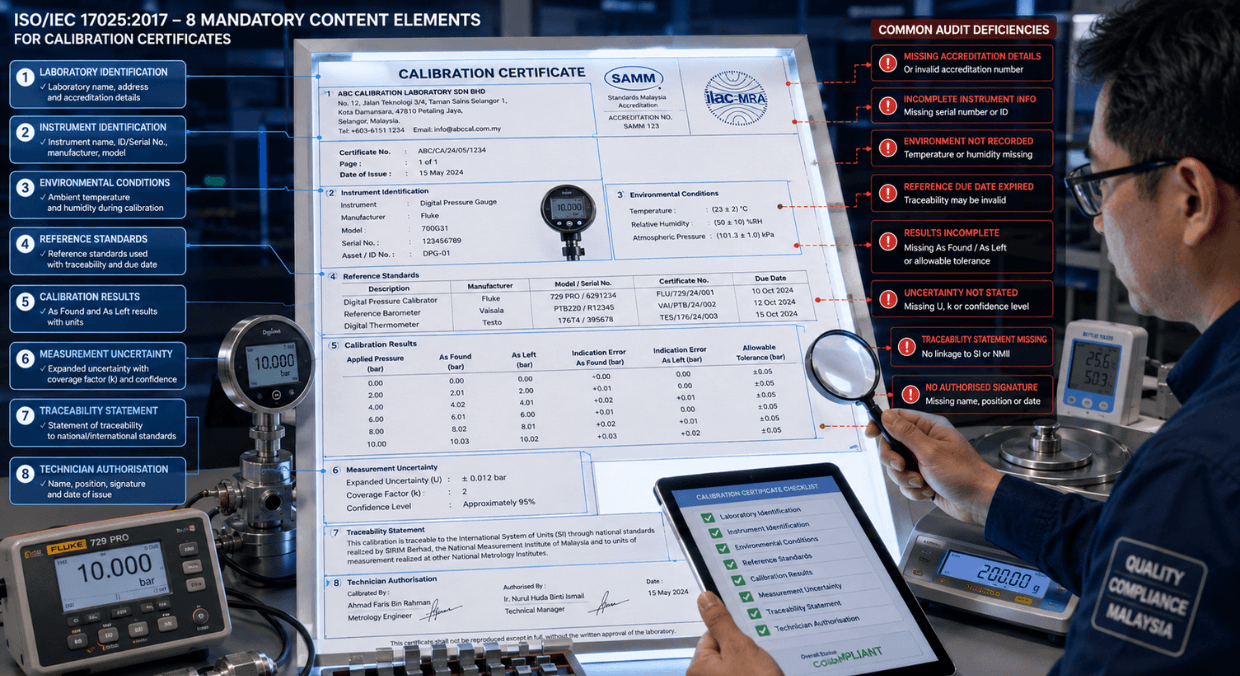
Before reviewing each element in detail, the table below shows what each must include and the most common deficiency found in Malaysian audit contexts.
Element | What It Must Include | Common Deficiency |
Laboratory identification | Name, address, accreditation number, ILAC MRA logo | Missing accreditation number or ILAC logo |
Instrument identification | Description, manufacturer, model, serial number, asset tag | Serial number only, no asset tag reference |
Date and environmental conditions | Date, temperature, humidity, pressure, where applicable | Environmental conditions absent |
Reference standards | Standard ID, certificate reference, uncertainty | “Traceable standards” without specific detail |
Calibration results | As-found and as-left measured values | Pass or fail statement only |
Measurement uncertainty | Expanded uncertainty at stated confidence level | Results without uncertainty figure |
Traceability statement | Named measurement institute and calibration chain | “Traceable to national standards” only |
Technician identification | Technician ID, reviewing authority, date of issue | Unsigned or no reviewer named |
Element 1: Laboratory Identification and Accreditation Details
What the Accreditation Number and ILAC MRA Logo Confirm
The document must show the laboratory name, address, accreditation body name, accreditation number, and scope reference. The ILAC MRA logo confirms independent assessment against ISO/IEC 17025 by a recognised accreditation body. Verify the accreditation number against the SAC or DSM online registry before accepting the document.
What to Check When the Laboratory’s Accreditation Number Is Absent
An absent accreditation number means the document is either from an unaccredited laboratory or was issued outside the laboratory’s accredited scope. Both situations mean the document lacks ILAC MRA standing. The first cannot be corrected. The second may require the work to be repeated within the accredited scope.
Element 2: Instrument Identification
What Must Be Recorded to Uniquely Identify the Instrument Being Calibrated
The minimum required is instrument description, manufacturer, model, and serial number. Asset tag or equipment tag reference must also appear so the document can be traced to a specific instrument in the facility’s equipment register.
Why Serial Number Alone Is Insufficient Without Asset or Tag Reference
Auditors trace documents from the asset register outward, not from the serial number inward. When multiple identical instruments are deployed at a facility, the serial number alone cannot distinguish which specific unit was assessed. The asset or tag reference makes this connection explicit and auditable.
Element 3: Calibration Date, Due Date, and Environmental Conditions
Why Environmental Conditions Must Be Recorded on the Certificate
Temperature and humidity must appear for most parameter categories. Atmospheric pressure is required for pressure and dimensional work. This is a measurement science requirement, not an administrative one. Environmental conditions affect measurement results and, therefore, affect the stated uncertainty values.
Whether Due Dates Must Appear and What Happens When They Do Not
ISO/IEC 17025:2017 does not require laboratories to state a next-due date. When one is absent, the facility’s own schedule determines the interval. Operators who rely on the document to set the interval have no basis for doing so when the laboratory does not provide one.
Element 4: Reference Standards Used
What Reference Standard Information Must Be Recorded and Why
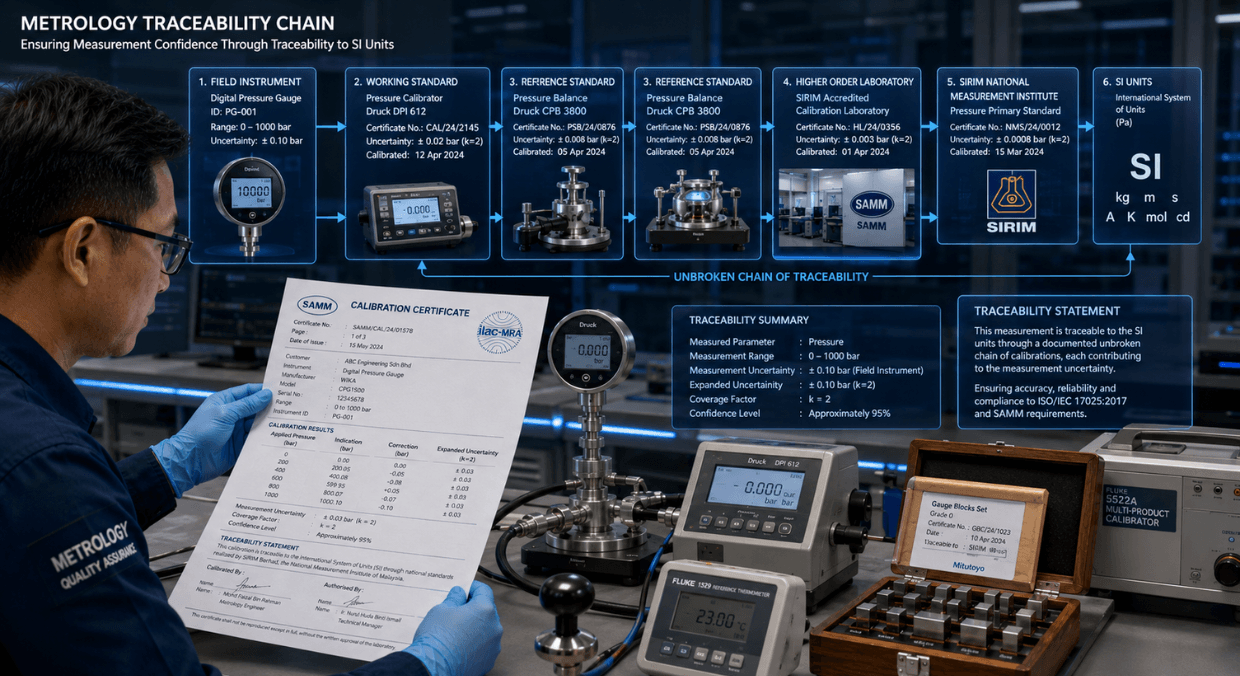
The document must identify each reference standard used, including the standard’s own certificate reference and stated uncertainty. This entry creates the traceability chain on paper, linking the instrument to a higher-order standard and ultimately to SI units.
How the Reference Standard Entry Creates the Traceability Chain on Paper
A complete traceability chain runs from the instrument being assessed to the reference standard, to the standard’s own assessment at a higher-order laboratory, and finally to the national measurement institute. Each link must be documented. A document that says “reference standards are traceable to SIRIM” without identifying the specific standards or their own references leaves the chain undocumented and unverifiable.
Element 5: Calibration Results
What “As Found” and “As Left” Results Mean and Why Both Matter
As Found records the instrument’s condition at the time the technician arrives, before any adjustment. As Left records the condition after any adjustment made during the session. The found data determines whether the instrument was in or out of tolerance before servicing. If it was out of tolerance, any measurements taken since the last assessment may be questionable. Auditors increasingly review As Found data for this reason.
When Pass/Fail Statements Alone Are Insufficient
A document stating only “Pass” or “Within Tolerance” without actual measured values cannot support a fit-for-purpose decision. The user cannot assess whether the instrument’s performance is acceptable for the specific tolerance required by the process it serves. Measured values must be present.
Element 6: Measurement Uncertainty
What Measurement Uncertainty Is and Why It Must Be Stated
Measurement uncertainty quantifies the range within which the true value of what was measured is expected to lie, given the limitations of the measurement process. Without it, the user cannot determine whether the instrument’s performance is acceptable for the tolerance the process requires. Expanded uncertainty must be stated at a specified confidence level, typically expressed as U at k=2, which represents approximately 95% confidence.
How Auditors Assess a Document That States Results Without Uncertainty
A document with results but no uncertainty cannot support a compliance decision. The auditor will flag it as incomplete and require recalibration from an accredited laboratory that evaluates and states uncertainty. The original document cannot be revised to add uncertainty because uncertainty must be evaluated at the time of the work, not added afterwards.
Element 7: Traceability Statement
What a Valid Traceability Statement Must Reference
The statement must confirm that measurements are traceable to SI units through an unbroken chain of assessments, each with stated uncertainties, linking to a national or international measurement standard. In Malaysia, this means a reference to SIRIM or an equivalent national measurement institute through a documented chain.
Why “Traceable to National Standards” Without Further Detail Is Insufficient
A generic traceability statement does not satisfy ISO/IEC 17025, PETRONAS documentation requirements, or GMP guidelines. It tells the auditor that traceability was claimed, not that it was demonstrated. Request from the laboratory a reference to the specific national measurement institute and the assessment reference that links the standards used to it.
Element 8: Technician Identification and Authorisation
What Technician and Authorisation Details Must Appear
The document must show the technician’s name or unique identification. It must also show the name or identification of the person who reviewed and authorised the document, as well as the date of issue.
How Digital and System-Generated Signatures Are Treated in Malaysian Audit Contexts
Unsigned or unauthorised documents may be rejected during audits, regardless of how complete the remaining content is. Digital signatures and laboratory management system-generated certificates are generally accepted in Malaysian audit contexts, provided they include unique technician and authoriser identifiers that can be verified against the laboratory’s personnel records.
How Different Malaysian Audit Contexts Assess Calibration Certificates
ISO 9001 and ISO 14001 Audits: What Auditors Typically Check
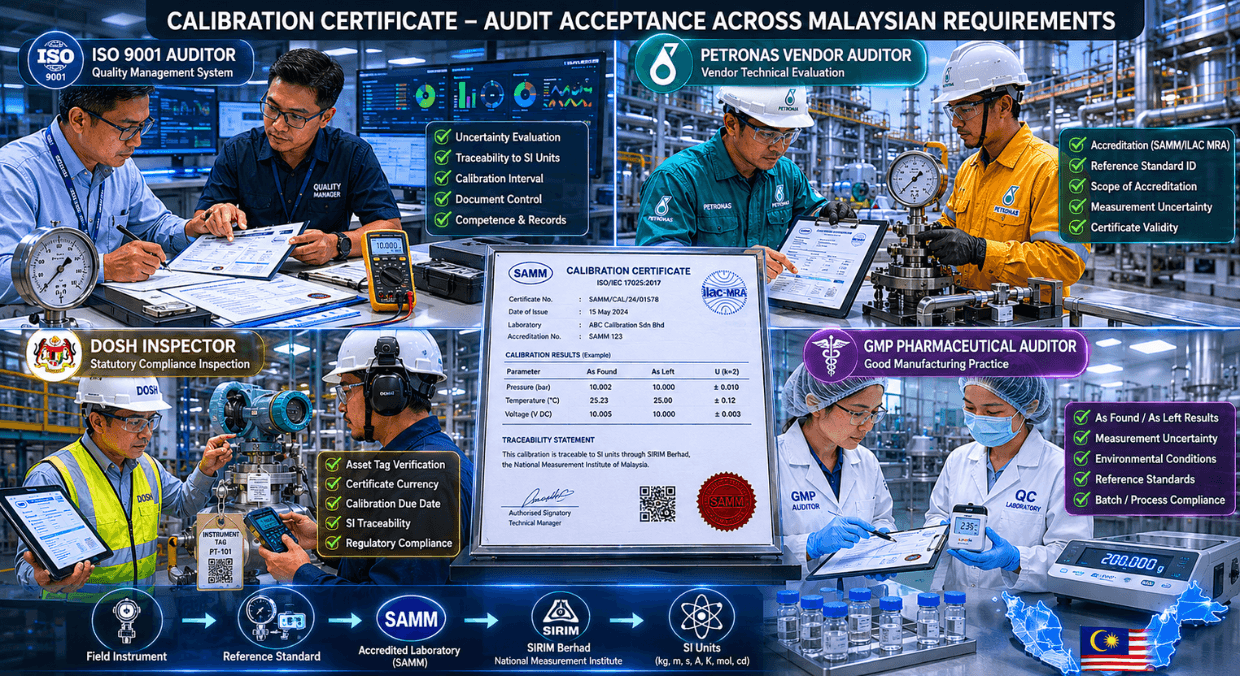
Auditors verify that the document demonstrates SI traceability, that the assessment date falls within the facility’s schedule, and that the instrument was in tolerance at its last review. Missing measurement uncertainty and generic traceability statements are the two findings most frequently raised in these audits.
PETRONAS Vendor Audits: Specific Requirements Beyond ISO Standards
PETRONAS vendor documentation requires accreditation scope coverage for the specific parameter being certified, full measured data, stated uncertainty, and complete reference standard identification. A document that satisfies an ISO audit may still fail a PETRONAS vendor review if reference standard details are missing.
DOSH Statutory Inspections: What Documentation the Inspector Reviews
For instruments subject to DOSH statutory inspection, the inspector reviews document currency, the accreditation status of the issuing laboratory, and whether the instrument identification matches the deployed asset. Out-of-date documents and those from unaccredited facilities are the most common findings.
Pharmaceutical GMP Audits: Why Full Measurement Data Is Required
GMP guidelines require the assessment process to demonstrate that an instrument meets its specified performance criteria. Pass-only statements and documents without measurement uncertainty are consistently flagged. Full As Found and As Left data, stated uncertainty, and reference standard identification are all expected as standard content.
What to Do When a Calibration Certificate Is Deficient
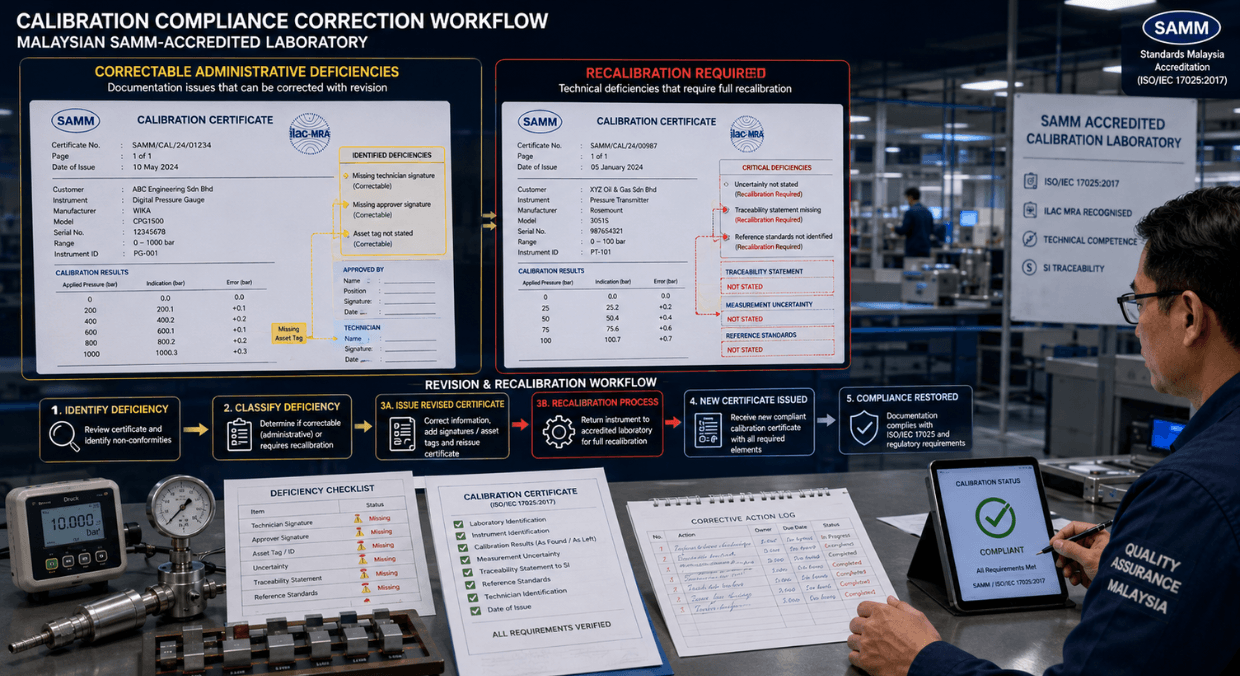
Deficiencies That Can Be Corrected: How to Request a Revised Certificate
Administrative deficiencies can be corrected by requesting a revised document from the laboratory: missing asset tag, incorrect date format, missing authorisation signature, or incomplete laboratory contact details. Document both the original and the revised version and keep both on file. The revision does not replace the original; it supplements it.
Deficiencies That Cannot Be Corrected Without Recalibration
Missing measurement uncertainty, missing reference standard data, and missing environmental conditions cannot be added to an existing document because they must be captured at the time of the work, not added afterwards. When these are absent, the work must be repeated by an accredited laboratory. If the instrument was out of tolerance, the previous interval’s measurement records may also require review.
How to Assess a Certificate Before Filing It, Not After the Audit
Review each of the eight mandatory elements at the point of receipt: laboratory identification and accreditation number, instrument identification including asset tag, date and environmental conditions, reference standard details, as-found and as-left results, measurement uncertainty with confidence level, traceability statement naming the measurement institute, and technician and authorisation identification. A document that fails any of these checks should be returned to the laboratory immediately rather than filed.
Atlantic Services Malaysia is a SAMM-accredited calibration laboratory in Malaysia that structures its documents to include all eight mandatory content elements required by ISO/IEC 17025:2017, with measurement uncertainty, full traceability statements, and reference standard details aligned to the specific audit contexts its clients operate in.
Conclusion
A compliant calibration certificate in Malaysia must contain eight mandatory elements: laboratory identification and accreditation details, instrument identification including asset tag, calibration date and environmental conditions, reference standard identification, as-found and as-left measured results, stated measurement uncertainty, a valid traceability statement naming the measurement institute, and technician and authorisation identification. The most common deficiencies causing rejection in Malaysian audits are missing measurement uncertainty, generic traceability statements, and absent reference standard identification. Deficiencies involving administrative details can be corrected with a revised document. Deficiencies involving measurement data, uncertainty, or traceability cannot be corrected without repeating the work from an accredited laboratory. Assessing each document against the eight mandatory elements at the point of receipt prevents audit-time rejection and protects the validity of every measurement decision that the instrument supports.