
When a Calibration Certificate Fails an Audit (And Why It Happens)
The Difference Between a Calibration Receipt and a Compliant Calibration Certificate

Not every document that says “calibration certificate” on it is one.
A compliant calibration certificate must contain specific technical information: measurement results, the reference standards used, measurement uncertainty values, and an unbroken traceability statement. A calibration receipt, by contrast, simply confirms that equipment was serviced or adjusted. It tells you nothing that auditors can verify.
Many small workshops issue calibration receipts but label them as calibration certificates. If you cannot see a stated uncertainty value or an accreditation body logo with a verifiable certificate number, what you have is not an audit-proof document.
Common Scenarios Where Calibration Records Are Rejected by Auditors
ISO 9001 and ISO 17025 Audits
[LINK: Clause 7.1.5 of ISO 9001 → https://www.iso.org/standard/62085.html] requires that measuring equipment be calibrated against measurement standards traceable to international standards, and that this be fully documented. Certificates without a stated traceability chain fail this check directly.
Petronas and Shell Vendor Qualification Assessments
Both companies require calibration certificates demonstrating [LINK: ISO/IEC 17025-accredited → https://www.iso.org/ISO-IEC-17025-testing-and-calibration-laboratories.html] lab issuance for critical process instruments. Non-accredited certificates are routinely rejected at the vendor document review stage.
Pharmaceutical and Medical Device Inspections Under GMP
GMP auditors require calibration documentation that includes uncertainty values and is traceable to national or international standards. Anything less creates a data integrity finding.
Why “We’ve Always Used This Lab” Is Not an Accreditation Argument
Familiarity with a vendor does not transfer to compliance. A lab you have used for five years without incident can still issue non-compliant certificates — and the first time it is formally checked is often during an external audit.
The problem is rarely that the equipment wasn’t calibrated. The problem is that it was calibrated by the wrong lab, or that the certificate it produced doesn’t meet the standard the auditor is checking against. By the time this surfaces, you are facing a non-conformance finding, a failed vendor assessment, or, in the most serious cases, a product recall investigation.
This guide gives you the framework to evaluate a calibration laboratory in Malaysia before that situation arises.
What Accreditation Actually Means — and What It Does Not
The ISO/IEC 17025 Standard Explained in Plain Language
What It Governs — Competence, Not Just Equipment
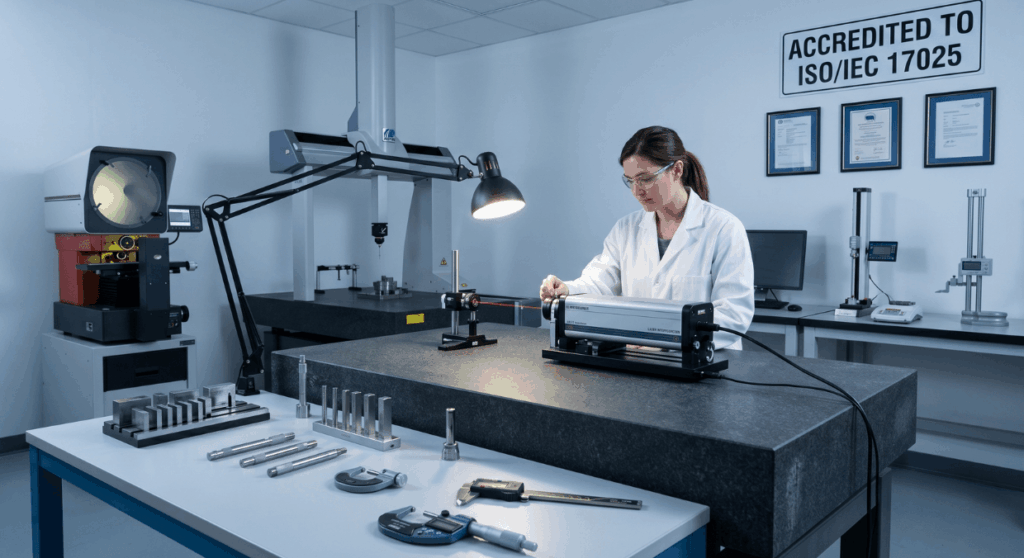
[LINK: ISO/IEC 17025:2017 → https://www.iso.org/standard/66912.html] is not a quality management standard. It assesses whether a laboratory is technically competent to produce valid measurement results, covering trained personnel, calibrated reference standards, validated methods, and a quality system that ensures consistency.
The Four Domains
The standard covers resource requirements (staff, equipment, environment), process requirements (method validation and uncertainty estimation), management requirements (document control and complaints), and technical requirements (measurement traceability).
Accreditation vs Certification: A Distinction That Matters in Calibration
ISO 9001 certification confirms that a quality management system is in place. ISO/IEC 17025 accreditation confirms technical measurement competence. A lab can hold ISO 9001 certification and still produce unreliable calibration results. Only accreditation addresses measurement validity directly.
Who Grants Accreditation in Malaysia
SAMM — Malaysia’s National Accreditation Scheme
(Skim Akreditasi Makmal Malaysia, administered by the Department of Standards Malaysia)
[LINK: SAMM is Malaysia’s national accreditation body → https://www.jsm.gov.my] and a signatory to the ILAC MRA. Accreditation status and scope can be verified directly on the DSM online registry.
SAC-SINGLAS — Singapore’s National Accreditation Body
[LINK: SAC-SINGLAS → https://www.sac-accreditation.gov.sg] is the Singapore Accreditation Council’s laboratory scheme. Labs accredited under SINGLAS are equally valid in Malaysia due to the mutual recognition arrangement explained below.
What ILAC MRA Means for Cross-Border Certificate Acceptance
The [LINK: ILAC Mutual Recognition Arrangement → https://ilac.org/ilac-mra-and-signatories/] means that accredited calibration certificates issued under any ILAC-signatory body (including SAMM and SAC) are accepted across all signatory countries. A SINGLAS certificate is as valid in a Malaysian audit as a SAMM-issued one.
What Accreditation Does NOT Guarantee
Accreditation is scope-specific. A lab accredited for dimensional instruments is not automatically accredited for pressure or electrical instruments. Always check the lab’s scope certificate and not just its accreditation status.
The 7 Things to Verify Before Engaging a Calibration Laboratory in Malaysia
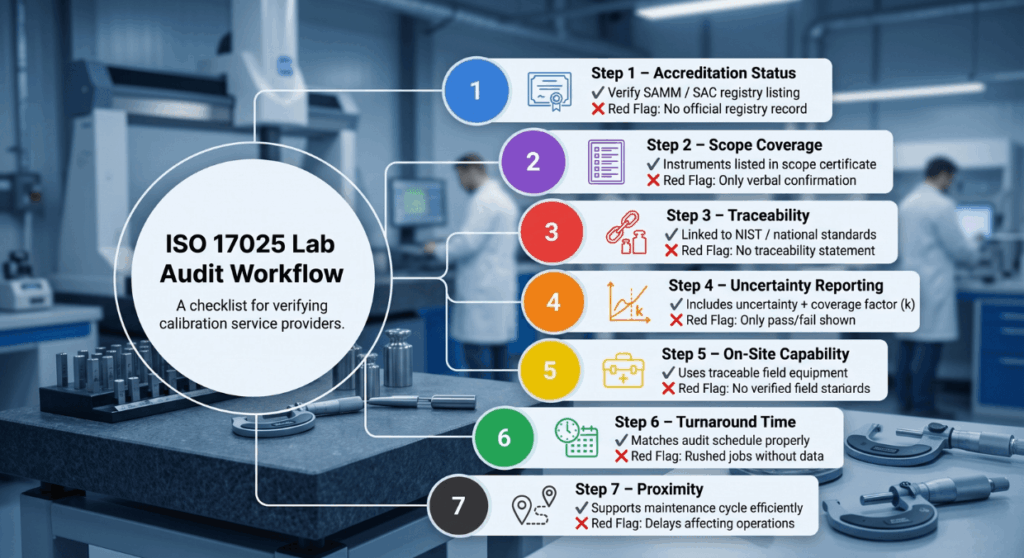
Understanding what accreditation means is the prerequisite, but the practical work is in knowing what to ask and where to look. Here is a structured way to do that.
Criterion | What to Check | Red Flag |
1. Accreditation status | Verify active listing on SAMM or SAC registry (not the lab’s website) | No registry listing found |
2. Scope coverage | Confirm your specific instruments appear in the lab’s scope certificate | Verbal assurance only |
3. Measurement traceability | Certificate states reference standards traceable to NMC, NIST, or equivalent | No traceability statement on the certificate |
4. Uncertainty reporting | Certificate includes measurement uncertainty values with coverage factor (k) | Certificate shows pass/fail only |
5. On-site capability | Lab holds portable, traceable reference equipment for field calibration | On-site offered, but no traceable field references confirmed |
6. Turnaround time | Timeline matches your audit schedule without compressing measurement work | Rush jobs with no uncertainty documentation |
7. Geographic proximity | Lab can support your maintenance cycle without excessive logistics delays | Transport times create equipment unavailability gaps |
Accredited vs Non-Accredited Calibration: When Does It Actually Matter?

Situations Where Accredited Calibration Is Non-Negotiable
Regulatory Inspections and Statutory Compliance
Any statutory requirement referencing measurement standards will require traceable, accredited calibration as a baseline expectation.
International Trade and MNC Supply Chain Requirements
Global supply chain audits, particularly from Japanese, European, and US parent companies, typically require [LINK: ILAC MRA-recognised certificates → https://ilac.org/ilac-mra-and-signatories/] as a minimum documentation standard.
ISO Management System Audits
ISO 9001, ISO 13485, and ISO 45001 all include calibration traceability requirements that can only be met with certificates issued by accredited laboratories.
Situations Where Non-Accredited Calibration May Be Acceptable
Internal monitoring equipment whose measurement results inform process decisions but are not used for product conformity determinations or regulatory submissions may not require accredited calibration. The key question: Does a failed audit, regulatory inspection, or customer requirement ever depend on readings from this instrument?
The Risk Calculus
Accredited calibration for a full instrument register typically costs a fraction of what a single failed audit costs in corrective actions, re-inspection fees, and production delays. The gap between compliant and non-compliant calibration is rarely a budget question. It is a risk awareness one.